
What Montgomery County Courts at Law Handle
A county court at law is a statutory trial court. The Texas Legislature creates each one by law and sets what it can hear. These courts sit between the justice courts below and the district courts above. They take the cases that are too big for a justice court but not at the felony level.
The work splits into three main groups. First come criminal misdemeanors. Most are Class A and Class B charges. Second are county civil cases that fall within the court's dollar limits. Third are appeals from the justice and municipal courts. Those arrive as a fresh trial. Each court can also take on tasks the Legislature gives it.
In Montgomery County, the courts at law carry a heavy load. They move thousands of cases a year. Pleas, hearings, and trials fill the docket. The judge runs that docket. The judge sets bond terms and signs the orders that close a case. The clerk keeps the paper and the data behind every step.
The Five Montgomery County Courts at Law
Montgomery County now has five county courts at law. They are numbered 1, 3, 4, 5, and 6. The gap in the numbers is not a mistake. County Court at Law 2 converted to a statutory probate court on October 1, 2023, so it no longer sits as a court at law. That change moved its probate and guardianship work under the probate bench.
Each court has its own judge. Each has its own courtroom and staff. Some sit in the Annex and Atrium buildings on West Davis. Others sit on North Main near the main courthouse. The judges are elected. They serve set terms. The table below lists each current court, its judge, its address, and its phone line.
| Court | Judge | Address | Phone |
|---|---|---|---|
| County Court at Law 1 | John C. Hafley | Annex Building, 210 West Davis, Suite 201, Conroe, TX 77301 | 936-539-7831 |
| County Court at Law 3 | Amy Tucker | 301 North Main, Suite 110, Conroe, TX 77301 | 936-539-7973 |
| County Court at Law 4 | Echo Hutson | 210 West Davis, Suite 400, Conroe, TX 77301 | 936-538-8174 |
| County Court at Law 5 | Keith Stewart | 210 West Davis, Suite 250, Conroe, TX 77301 | 936-538-3615 |
| County Court at Law 6 | Scharlene W. Valdez | 301 North Main, Office Suite 107, Courtroom Suite 113, Conroe, TX 77301 | 936-538-5380 |
Use the table to match a court to a judge and a place. If your paperwork names a court number, that tells you where the case sits. The County Clerk indexes each file by court, so the number helps when you search the online system too.
How to Search Montgomery County Court at Law Records
The County Clerk holds the records for all five courts at law. The clerk runs the County Clerk Odyssey site for public case lookups. It is the same Tyler Technologies system the district side uses, so the screens look familiar. The difference is the data behind them. The county side covers misdemeanor, county civil, and probate files, not felony or family district cases.
Start by picking a location on the menu. The county site lists All County Courts, Criminal Records, Civil and Probate Case Records, and a Court Calendar. Choose Criminal Records for a misdemeanor case. Choose Civil and Probate Case Records for a county civil suit. Then enter a party name or a case number and narrow by court and date. You can open the County Clerk Odyssey portal at odyssey.mctx.org.
If a name search returns too many hits, add a date range to trim the list. If it returns nothing, check your spelling and try the other location option. The County Clerk page explains the office and its tools in more depth. For a broad view of both clerks and how the county splits its files, see the court records overview. To track a setting or a hearing time, the court dockets page covers the calendar search.
Online results are great for a case number, a party name, or a filing date. They are not a substitute for the official file. When you need a document for a legal use, get a certified copy from the clerk.
Misdemeanor Cases in the Montgomery County Courts at Law
Most misdemeanor crime in the county runs through these courts. Class A and Class B charges are the core of the criminal docket. A Class B might be a first DWI. It might be a low-level theft. A Class A might be a second DWI or an assault with injury. These courts hear the bulk of such cases.
A felony is a different animal. Those cases go to the district courts, not the courts at law. The district court page covers that higher level, where the most serious crimes and the largest civil suits are tried. The split matters when you search. A felony record sits with the District Clerk. A misdemeanor record sits with the County Clerk. Look in the wrong place and you find nothing.
A misdemeanor case file can show a complaint, an information, a bond, plea papers, reset forms, and a final judgment. The docket lists each step in order. The District Attorney prosecutes the case for the State, and the judge presides. Class C fine-only matters, by contrast, stay down in the justice and municipal courts.
County Civil Cases and Appeals From Lower Courts
The Montgomery County courts at law also hear civil suits. These are county-level cases. They fall within the dollar limits set by statute. Think contract disputes, debt claims, and property matters. Such money suits sit above the justice court line but below the district court range. The judge can hear the case with a jury or without one.
Appeals are the other big piece. A party who loses in a justice court or a municipal court can often appeal to a county court at law. In most of these cases the appeal is a trial de novo. That means the county court hears the matter fresh, as if the first trial never happened. New evidence and new testimony come in, and the judge or jury decides again.
Not every municipal case works this way. Some city courts are courts of record, and an appeal from one of those rides on the trial record instead of starting over. The path depends on the court that tried the case first. The county court at law is where many of these everyday appeals land.
Note: the court clerk can tell you how to file and what forms to use, but staff cannot tell you whether to appeal or how your case will turn out.
Note: An appeal to a county court at law often starts the case over as a brand new trial, so the lower court's ruling does not carry forward.
Montgomery County Court at Law vs District and Justice Courts
It helps to see the three trial levels side by side. Each one hears a different slice of cases, and each one reports to a different clerk for records. The table below sets the county court at law next to the district court and the justice court so you can tell them apart at a glance.
| Feature | County Court at Law | District Court | Justice Court |
|---|---|---|---|
| Case types | Misdemeanor crime, county civil, appeals from lower courts | Felony crime, major civil, family and divorce | Small claims, evictions, debt claims, fine-only crime |
| Criminal level | Class A and Class B misdemeanors | Felonies | Class C misdemeanors |
| Civil scope | County-level suits within statutory limits | Large civil suits with no upper cap | Small civil claims up to the justice limit |
| Clerk / custodian | County Clerk | District Clerk | The justice of the peace precinct |
Read the table from the case you have. If your matter is a misdemeanor, the middle column is yours. If it is a felony or a divorce, you want the district side. If it is a small claim or an eviction, it sits at the justice level. Match the case to the court, then match the court to the right clerk.
Where the Montgomery County Courts at Law Sit
All five courts sit in downtown Conroe. They cluster on two streets near the main courthouse campus. Some courts are at 210 West Davis, in the Annex and Atrium buildings. Others are at 301 North Main, close to the county courthouse itself. The two sites are a short walk apart in the heart of downtown.
County Court at Law 1 sits in the Annex Building on West Davis. Courts 4 and 5 are also on West Davis. Courts 3 and 6 are on North Main. The address on your notice or summons tells you which building to enter. Get there early and bring a photo ID, since the courthouse runs security screening at the door.
The contact card below shows one of the courts as a quick example. For the full list of judges, addresses, and phone and fax lines, check the official county page.
The county lists each court at law, its judge, and its contact block on the official courts page. Here is that Montgomery County courts at law page.
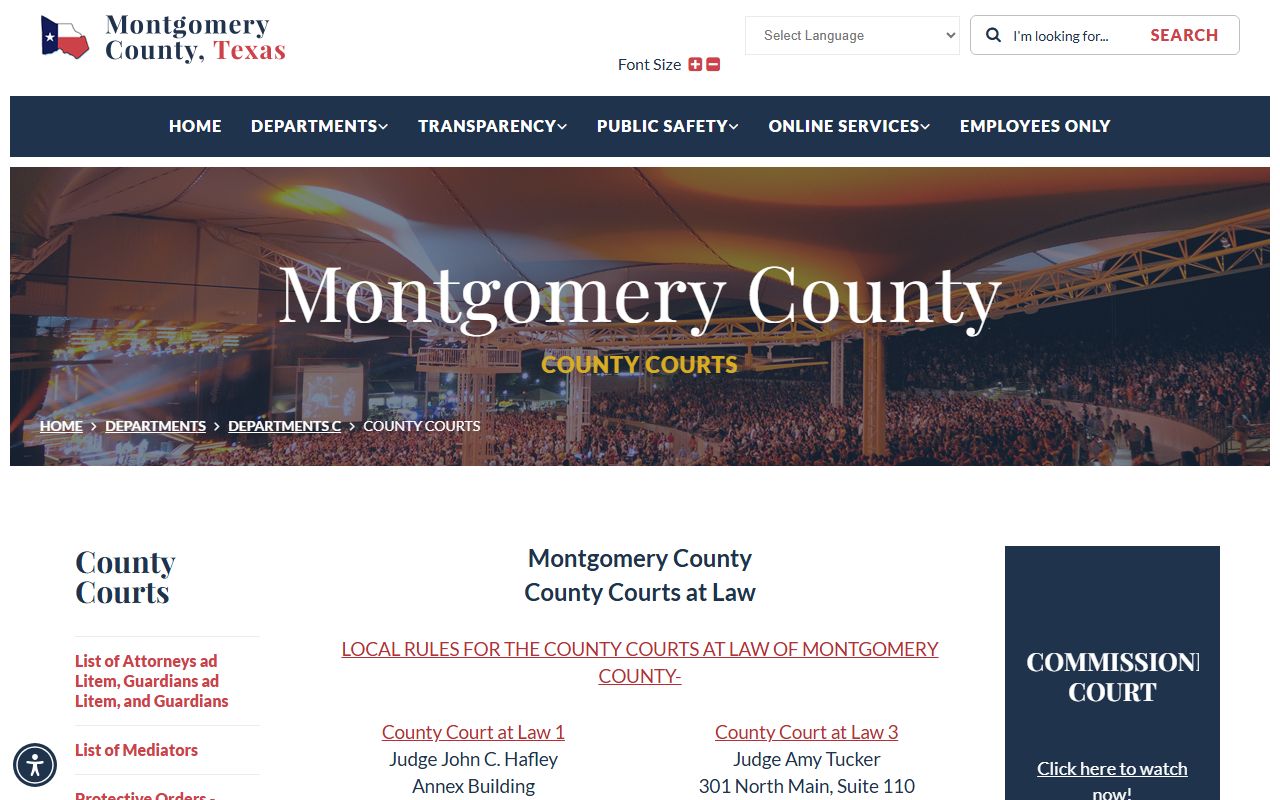
The page also links standing orders, mediator lists, and ad litem resources for each court. Use it to confirm a current judge or a phone number before you call.
Montgomery County Court at Law 1
Annex Building, 210 West Davis, Suite 201
Conroe, TX 77301
936-539-7831
Judge John C. Hafley
Records, Fees, and Certified Copies in Montgomery County
The County Clerk is the records custodian for the courts at law. L. Brandon Steinmann holds that office. The clerk keeps the criminal, civil, and probate files. The clerk also runs the public search tools. Need an official document? You go to the clerk, not the judge or the court staff.
There is a real difference between the kinds of copies. A public inspection lets you read a file. A plain copy is a simple printout with no seal. A certified copy carries the clerk's seal and a statement that it is a true copy, which courts and agencies need for legal use. Each copy type can carry its own fee, and certified copies usually cost more than plain ones.
The clerk sets copy and certification fees under state law, and amounts change over time. Check the current fee with the County Clerk before you ask for a copy, since published amounts are the only reliable figures. A good request is specific: name the case number, the parties, the court, and the exact document you want. The County Clerk page lists the office locations and tools, and the probate records page covers wills, estates, and guardianship files that the same clerk keeps.
One last point. The clerk can hand you forms and explain the steps, but staff cannot give legal advice. Texas law bars clerks from the unauthorized practice of law. If you need advice on your case, talk to a lawyer or a legal aid group.