
How to Search Montgomery County Court Records
The county uses more than one official system, so the right portal depends on the court level and the record type. District court cases run through the District Clerk Odyssey Public Access site. County court and probate cases run through a separate County Clerk Odyssey site. Recorded public records, such as deeds and marriage records, sit in the County Clerk Official Records Search. Picking the correct system first saves time. A felony search in the county misdemeanor system will return nothing, even when a case exists.
Before you start, gather what you know. A full name, a case number, or a recorded date range all help. Spelling matters. A middle name or a date of birth can narrow a common name. Have a second portal ready in case the first one shows no result.
- Decide which clerk owns the case. District Clerk for felony, family, divorce, and major civil; County Clerk for misdemeanor, probate, and county civil.
- Open the matching Odyssey portal and pick a location, such as Criminal Records, Civil and Family, or Court Calendar.
- Enter a party name or a case number, then narrow by court type and date.
- Review the docket entries, parties, filing date, and case status that the result returns.
- Request a certified copy from the clerk if you need an official document for a legal use.
County online services are gathered on the official Montgomery County government site, which links the clerks, courts, ticket payment, and the jail roster.
The county homepage at mctx.org is the central hub for court and clerk links across the county.

From that homepage you can reach the District Clerk, the County Clerk, the justice courts, and the online case search tools without hunting for separate addresses.
Which Clerk Keeps Which Montgomery County Court Records
Texas uses a split clerk model, and Montgomery County follows it. The District Clerk, Melisa Miller, keeps district court records. That covers felony criminal cases, divorce and family cases, and major civil suits. The County Clerk, L. Brandon Steinmann, keeps county court at law records, probate cases, commissioners court minutes, vital records, and recorded public records. When a search fails, the case may simply belong to the other clerk.
This split is the single most useful thing to learn before you search. It explains why one county can have several different portals. It also explains why a divorce and a probate estate, both family matters in plain speech, are filed with two different offices.
| Question | District Clerk | County Clerk |
|---|---|---|
| Court level | District courts | County courts at law, probate |
| Criminal | Felony cases | Class A and B misdemeanors |
| Civil and family | Divorce, custody, major civil | County civil within limits |
| Other records | Jury, passports, e-filing | Probate, marriage, deeds, vital |
The Montgomery County Court System
Montgomery County sits inside the Texas court structure, which runs from local courts up to two high courts. The county has eight district courts, five county courts at law, a statutory probate court, and five justice of the peace precincts. City cases go to municipal courts. Each level hears a defined set of cases, and that scope decides where a record lives.
District courts are the general trial courts. They handle felonies, divorce and family suits, and large civil disputes. County courts at law handle misdemeanors and lower civil matters. Probate Court No. 1 handles wills, estates, and guardianships. Justice courts handle small claims, evictions, and fine-only tickets.
Case flow: Justice Court › County Court at Law › District Court › Court of Appeals
| Court | Jurisdiction | Case Types |
|---|---|---|
| District Courts | General trial, statewide grant | Felony, divorce, family, major civil |
| County Courts at Law | County-level, statutory limits | Misdemeanor, county civil, appeals |
| Probate Court No. 1 | Statutory probate court | Wills, estates, guardianship |
| Justice Courts | Precinct level | Small claims, eviction, Class C |
| Municipal Courts | City level | City ordinance, traffic |
The county also routes case settings through the justice of the peace precincts, which post their own payment and court-date tools.
The justice of the peace landing page links all five precinct courts in one place.
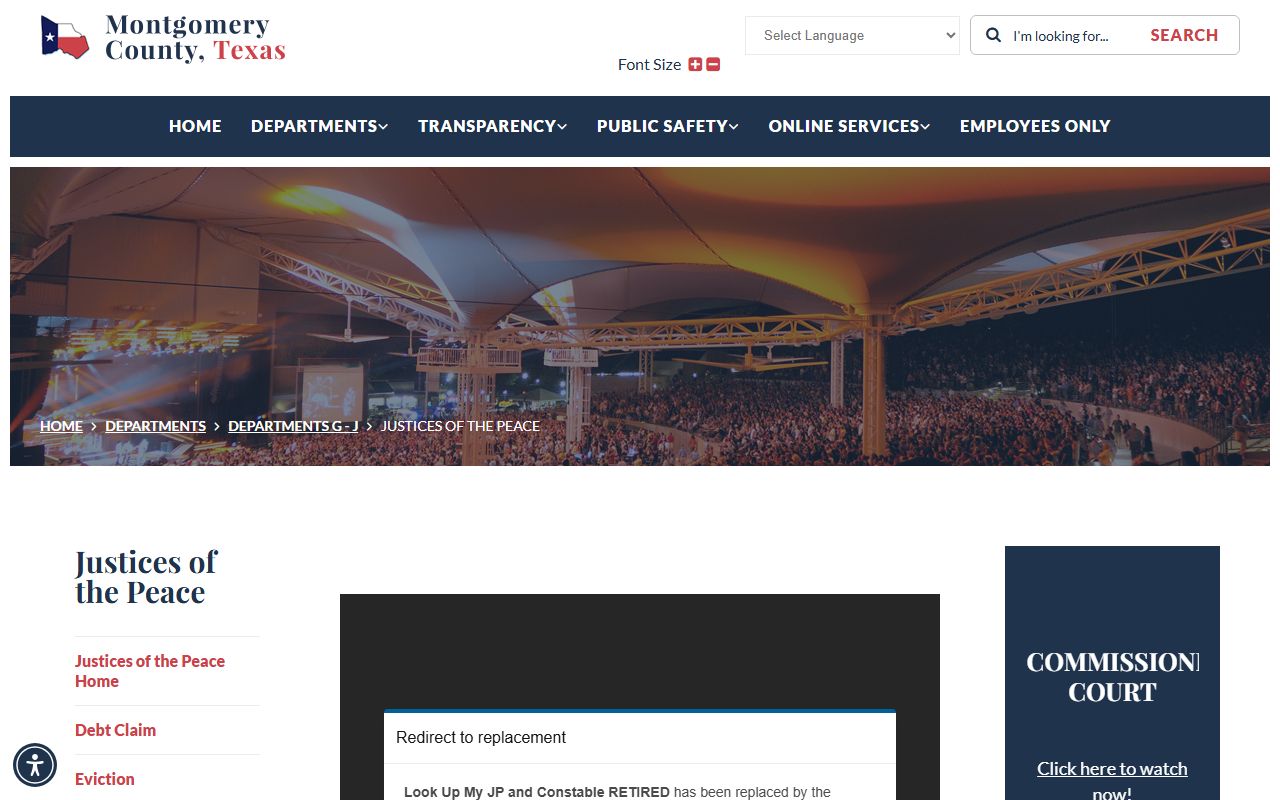
If a citation or small claim is not in the district or county portals, it most likely sits with one of these precinct courts instead. More detail lives on the Montgomery County District Court and Courts at Law pages.
Montgomery County Courthouses
The county does not use one single courthouse. Downtown Conroe works more like a court campus, spread over a few blocks. The District Clerk and several district courtrooms sit at 301 North Main Street. The County Clerk, the probate court, and some county courts sit at 210 West Davis. The District Attorney is close by on West Phillips. A visitor headed to a Montgomery County court should confirm the building, suite, and clerk window before driving in.
Types of Court Records Available in Montgomery County
Montgomery County court records cover many kinds of cases. The records you can view depend on the court and on Texas access rules. Most case dockets and filings are open to the public. Some files, or parts of files, are sealed or redacted by law.
The list below groups the main record types and the court that produces each one. A single event can create more than one record. An arrest, for example, creates a sheriff jail record and, later, a court file.
- Criminal records - felony files at the district level and misdemeanor files at the county level.
- Civil records - lawsuits, contract disputes, property suits, and money judgments.
- Family and divorce records - district court cases for divorce, custody, and support.
- Probate records - wills, estate administration, heirship, and guardianship.
- Traffic records - JP and municipal court citations, separate from your state driver record.
Full detail on each track sits on the Montgomery County court records page and the arrest records page.
What Montgomery County Court Records Show
A court record is built from many small fields. The case-management system, Odyssey, ties them together under one case number. When you open a result, you usually see the parties, the filing date, the case type, the status, and a list of docket entries. Sensitive items are redacted. Social Security numbers, driver license numbers, and bank account numbers do not appear in the public view.
| Field | What It Shows |
|---|---|
| Case Number | The unique ID the clerk assigns, often by year and sequence. |
| Filing Date | When the petition, information, indictment, or application was filed. |
| Parties | Plaintiff and defendant, petitioner and respondent, or the State and the accused. |
| Charges / Cause | The offense charged or the civil claim that started the case. |
| Disposition | The outcome, such as dismissed, guilty plea, judgment, or pending. |
| Sentence / Judgment | The punishment or the court order entered after a finding. |
Public Access Laws for Montgomery County Court Records
Texas treats most government records as open unless a statute, a court rule, or a court order makes them private. The Texas Public Information Act covers many county and sheriff records. Court files follow judiciary rules on top of that. So a record can be public at the clerk even when a related agency record is held back. The key is to find the right custodian and the right law.
Key Statutes:
Texas Government Code § 552 - the Public Information Act, which makes county and sheriff records open unless an exception applies.
Texas Government Code § 51 - sets the duties and record-keeping rules for district and county clerks.
Texas Code of Criminal Procedure § 55 - allows eligible arrests and cases to be expunged from public files.
Texas Health and Safety Code § 611 - protects mental health records inside court and jail files.
Mental health files are a clear example of records the law keeps closed to the general public.
You can read the full text of the mental health confidentiality rules on the state statutes site.
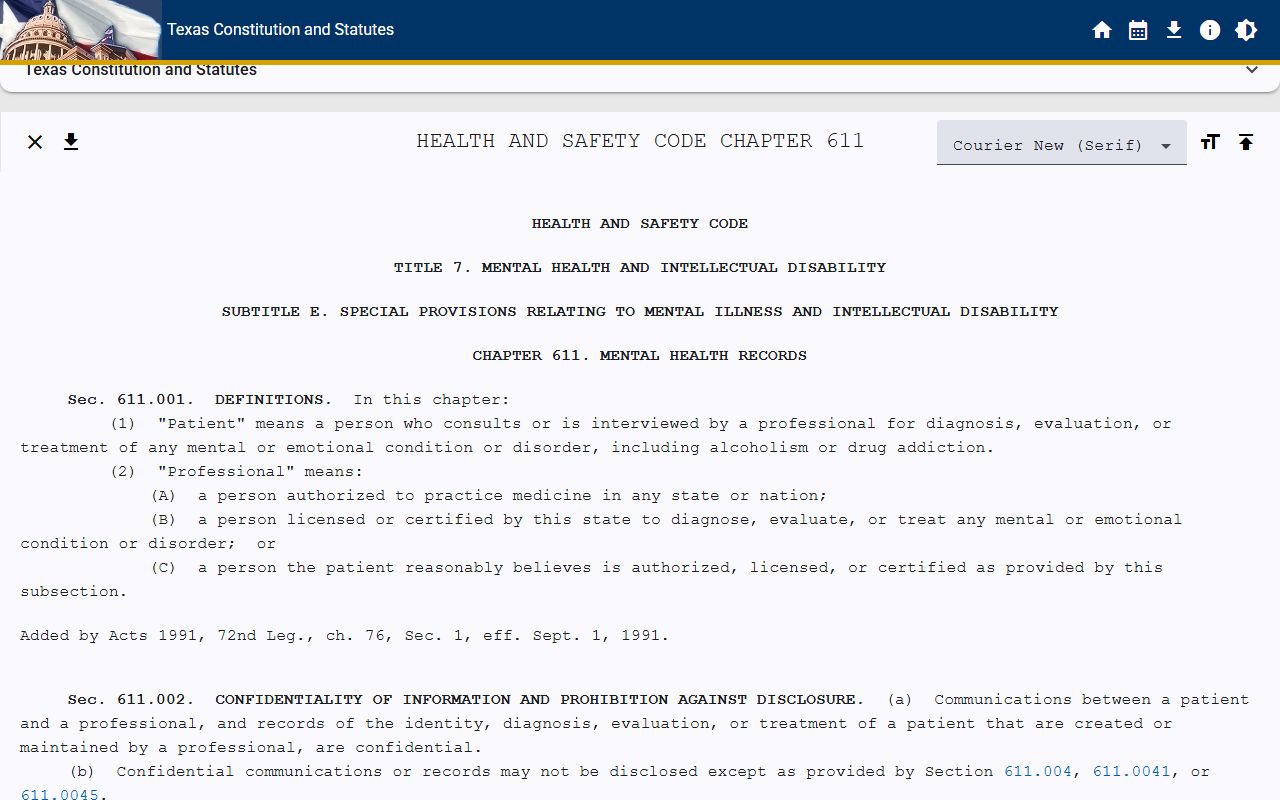
Because of rules like this, a "no record found" result does not always mean no case exists. The file may be sealed, restricted, or simply filed with a different office.
Records That Are Restricted or Confidential
Some Montgomery County court records are closed by law. Juvenile justice records are restricted under Texas Family Code Chapter 58. Adoption records are confidential under Chapter 162. Mental health files, grand jury material, and sealed civil records also stay out of public view. Expunged records are removed from public systems entirely.
To view a sealed record, you usually need standing and a court order. A party, an attorney, or an authorized agency may have access that the public does not. The path is a motion or a clerk procedure, not an open-records request. Clerks cannot decide these questions, and they cannot give legal advice.
Specialty Courts in Montgomery County
Montgomery County runs problem-solving courts alongside its regular dockets. These programs mix court supervision with treatment and services. The official district courts page links a Drug Court, and the 359th District Court lists a Veterans Treatment Court. County navigation also lists Mental Health Court Services.
Drug Court serves eligible defendants who have substance-use needs. It uses judicial review, testing, case management, and graduated rewards or sanctions. Veterans Treatment Court serves eligible veterans whose cases tie back to service-related issues, such as trauma or substance use. It connects them with VA and community help. Mental Health Court Services coordinate treatment and compliance for defendants with mental health needs. Because medical details are private, public pages describe the process, not the people in it.
Montgomery County Sheriff and Jail
The Montgomery County Sheriff's Office runs the county jail at #1 Criminal Justice Drive in Conroe. Sheriff Wesley Doolittle leads the office, and Captain Jeremiah Richards heads the Jail Command. The jail holds people awaiting trial, people serving county sentences, and felony convicts waiting to transfer to state prison. Arrest and jail records are sheriff records. They are not the same as the court file, which is created later by the clerk.
For booking status, booking photos, and the roster, use the Montgomery County inmate records page. For active warrants, see the warrant records page. For people who have left custody, the released inmates page explains how to confirm a release.
Marriage, Divorce, and Probate Records
The County Clerk issues marriage licenses and keeps marriage records. Divorce is different. A divorce is a district court family case, so the District Clerk keeps the file. Probate, which deals with wills and estates, runs through Probate Court No. 1 and the County Clerk. The marriage and divorce records page and the probate records page cover each one in full.
- Testator
- The person who made a will.
- Executor
- The person named in a will to settle the estate.
- Conservator
- A person a court names to manage another adult's affairs or care.
Montgomery County Court Records Fees
Fees for copies and filings are set by statute and by official county fee sheets, not by guesswork. The County Clerk posts a recording fee sheet and a vital records fee sheet on its site. The District Clerk posts its own records and fee information. Plain copies cost less than certified copies, because a certified copy carries the clerk's official seal. A records search by staff may add a fee for the time involved.
| Item | Where to Confirm the Amount |
|---|---|
| Plain copy of a record | County Clerk or District Clerk fee schedule |
| Certified copy | County Clerk fee sheet (adds a certification charge) |
| Marriage license | County Clerk vital records fee sheet |
| In-office card payment | Some courts add a card fee, such as a 5% charge at JP2 |
Check the current fee sheet at the County Clerk site before you mail a payment, since amounts change.
How to Interpret Montgomery County Court Records
Court files use a lot of shorthand. A charge is not a conviction. A "disposition" is the outcome, while the "judgment" is the court's written decision. In Texas, "deferred adjudication" means the court holds off on a finding of guilt while the person completes supervision. "Community supervision" is the Texas word for probation. A "capias" is a writ that orders an arrest, often after a missed court date.
Reading these terms correctly keeps you from drawing the wrong conclusion. A dismissed case and a conviction are very different things, even when both appear in the same search.
Accuracy and Record Limitations
Online records lag behind the courtroom. A clerk has to enter a filing before it shows up, and busy dockets can slow that down. The warrant portal carries a strong disclaimer that it is not an official court record. Jail roster counts shift hour to hour as bookings, releases, and transfers happen.
Note: Always confirm a court date, a bond, or a final outcome with the clerk that holds the file before you rely on an online record.
Self-Help and Legal Aid Resources
Clerks cannot give legal advice, so people without a lawyer need other help. The District Clerk links self-help resources, protective order forms, and local rules. Several district courts post pro se guides. For criminal cases, the county Office of Indigent Defense, at 301 North Main, Room 304, handles appointed counsel for eligible defendants.
Statewide help is free and reliable. TexasLawHelp offers plain-language forms for divorce, custody, eviction, and expunction.
You can browse those guides directly at TexasLawHelp, run by the state's legal aid groups.
For eligible low-income residents, Lone Star Legal Aid is the main regional civil legal aid provider for southeast Texas.
Its services are described on the Lone Star Legal Aid site, which covers family, housing, and consumer matters.

The State Bar of Texas Lawyer Referral Service can also point you to a private attorney for a paid consultation.
History of Montgomery County Courts
Conroe has long been the county seat, and the court campus grew with the county. What began near a single courthouse now spreads across buildings on Main, Davis, Phillips, and Thompson. The county added courts as it grew. A recent change shows that growth in action: as of October 1, 2023, County Court at Law No. 2 converted into a statutory probate court.
Technology has changed how the records work too. The county moved district and county case search onto Odyssey Public Access. The official records search now offers full-text OCR. One district court even posts a standing order on the use of artificial intelligence in filings, a rare local detail.
Frequently Asked Questions
Which office keeps Montgomery County court records?
It depends on the court level. The District Clerk keeps district court records, including felony, family, divorce, and major civil cases. The County Clerk keeps county court at law records, county misdemeanors, probate, and public records. Justice and municipal courts hold their own files. If one portal shows no result, try the other before you assume there is no case.
Where do I search district court cases?
Use the District Clerk Odyssey Public Access portal. The location menu includes All Courts, Criminal Records, Civil and Family Case Records, and Court Calendar. Pick Criminal Records for felony matters, Civil and Family for divorce and family suits, and Court Calendar for hearing dates. The court records page walks through the steps.
How do I get a certified copy?
Certified copies come from the clerk that holds the record. For district court files, contact the District Clerk. For county court, probate, marriage, birth, and death records, contact the County Clerk. Online portals may show results or images, but a certified copy needs a clerk transaction and a fee.
How do I find an inmate or a court date?
For custody status, use the jail roster. The jail does not assign or track court dates. For a felony court date, contact the District Clerk; for a misdemeanor date, contact the County Clerk, or use the Odyssey Court Calendar search.
More answers sit on the Montgomery County court records FAQ page.