
How to Look Up Montgomery County Jail Population Data
Jail population data is not one number on one page. It is a set of figures kept by different bodies. The main source for Texas county jails is the Texas Commission on Jail Standards. The agency, known as TCJS, collects a count from every county jail in the state. It then posts that data in monthly reports. You can reach these reports through the Texas Commission on Jail Standards homepage. The site holds population reports and an incarceration rate report that lists county figures.
The Sheriff's Office is the second source. The agency runs the jail and tracks its own numbers. The Montgomery County Sheriff's annual report can include bookings, staffing, and population for the year. That report is linked from the Sheriff's homepage navigation. For national context, the Bureau of Justice Statistics, or BJS, publishes jail data for the whole country. Each source updates on its own clock. TCJS reports come out month by month. The Sheriff's annual report comes out once a year. BJS data sets lag, since they pull from a national survey.
So the steps are simple. Pick the question first. For a current Texas count, read the TCJS monthly report. For a yearly local view, read the Sheriff's annual report. For the big picture, read BJS. Each one tells you the date its figures were pulled. Always check that date. A number from last year is not the same as today's count. For the name of a single person in custody, that search runs through the inmate records page instead.
Montgomery County Jail Capacity Overview
Capacity means the number of beds a jail is rated to hold. It is not the same as how many people are in the jail right now. TCJS sets and tracks the rated capacity for each Texas county jail. The agency lists that figure in its reports. The exact capacity for the Montgomery County Jail is published by TCJS, so the rated bed count should be confirmed there rather than guessed. The main jail sits at #1 Criminal Justice Drive in Conroe.
The Sheriff's Office also notes a key local fact. Montgomery County has partnered with Waller County to house some inmates due to overcrowding. That tells you the local count has, at times, pressed against available beds. Inmates moved to Waller County still appear on the Montgomery County roster. Their housing location reads "Waller Co Jail." They remain Montgomery County inmates, and they are released through Montgomery County. The table below shows where each facility's bed figure can be confirmed.
| Facility / Housing | Address | Where to Confirm Capacity | Notes |
|---|---|---|---|
| Montgomery County Jail | #1 Criminal Justice Drive, Conroe, TX 77301 | Published in TCJS monthly report and incarceration rate report | Main county jail; holds misdemeanor and felony inmates, pretrial and sentenced. |
| Waller County overflow housing | Waller County Jail | Counted within Montgomery County figures in the TCJS report | Used due to overcrowding; roster location reads "Waller Co Jail." Inmate stays a Montgomery County inmate. |
Capacity is reported in a few ways. There is the total rated capacity. There is also a working figure that leaves a margin of empty beds for safety and classification. A jail rarely runs at 100 percent. Read the TCJS report to see both the rated number and the share of beds in use.
Average Daily Population in Montgomery County Jail
The average daily population, often shortened to ADP, is the mean number of people held across a set period. It smooths out the day-to-day swings. A jail might book 40 people one day and release 35 the next. The ADP irons that out into one steady figure. TCJS reports the data used to build this measure for each county. The exact ADP for the Montgomery County Jail comes from those reports, so it should be read straight from TCJS rather than estimated here.
ADP is not the same as a point-in-time count. A point-in-time count is a snapshot. It is the headcount on one day, at one hour. The jail roster gives you that kind of snapshot. ADP, by contrast, is an average over weeks or months. Both are useful. The snapshot tells you the load today. The average tells you the trend. When you read any figure, check which kind it is.
Note: Roster counts change hourly as the jail books new arrivals, releases people on bond, runs warrant checks, and moves inmates between facilities.
Demographic Breakdown of the Montgomery County Jail Population
A jail population is more than a single total. It breaks down by sex, by race, by age, and by charge. TCJS reports group jail data into set categories. The monthly report separates the count by gender and by status. It also tracks subsets like people held on contract from other agencies. The exact demographic figures for Montgomery County are not stated here, because they belong in the TCJS report and shift each month.
Reading a breakdown takes care. A category like "pretrial felons" counts people charged with a felony who have not yet had a trial. A category like "convicted misdemeanants" counts people serving a county sentence for a lesser crime. The TCJS form spells out each label. When you pull the report, match the label to the question you came with. Do not mix a charge category with a status category, since they measure different things.
Local context helps explain the size of any breakdown. The county is large and growing fast. More people generally means more cases and a bigger jail population to sort into these groups. For the exact share in each category on a given month, the TCJS county report is the source to read.
Pretrial vs Sentenced Population in Montgomery County Jail
One of the most important splits in any jail is pretrial versus sentenced. The two groups are held for different reasons. A pretrial inmate has been charged but not convicted. That person is held while a case moves through court, often because bond has not been posted. A sentenced inmate has been convicted and is serving time. The Montgomery County Jail holds both, plus a third group, and the law presumes a pretrial person innocent until a court rules.
The Sheriff's Office describes that mix plainly. The jail houses people awaiting trial, people convicted and serving county sentences, and people convicted of felonies who are waiting to transfer to the Texas Department of Criminal Justice. That last group is key. A county jail is not a state prison. Long felony sentences are served in TDCJ units, not the county jail. But after a felony conviction, a person may sit in the county jail for a stretch before the state takes custody.
TCJS tracks the pretrial and sentenced counts for each county. The exact ratio for Montgomery County is published in those monthly reports. The pretrial share matters for policy. A high pretrial count can point to bond practices, court backlogs, or case volume. Read the TCJS report to see where the county stands. For how a charge becomes a case, see arrest records.
Misdemeanor vs Felony Population in Montgomery County Jail
Charges split into two broad levels. A misdemeanor is a lesser crime. A felony is a serious one. The Montgomery County Jail holds people on both. The level of the charge shapes where a person ends up and how long they may stay. A misdemeanor sentence is served in the county jail. A felony sentence, once long enough, moves to the state system.
This split overlaps with the pretrial and sentenced split, but it is not the same thing. A person can be a pretrial felon, a sentenced misdemeanant, or a felon awaiting state transfer. Each is a distinct slice of the count. TCJS reports break the population down by these labels. The exact number in each slice for Montgomery County belongs in the TCJS report, since it changes from month to month.
Why does the mix matter? Felony cases tend to take longer. They can keep a person in the jail for a longer stretch before resolution or transfer. A jail with a heavy felony load can feel pressure even when total bookings hold steady. The TCJS county figures show this mix clearly.
Mental Health and Medical Population
Some people in jail need medical or mental health care. Jails track this group so they can staff and house people safely. The detail here is kept general on purpose. Individual medical and mental health records are confidential under state and federal law. No public report names a person or shares a diagnosis.
TCJS does collect aggregate data tied to mental health screening. Texas jails screen people at intake for mental health needs and for suicide risk. The counts that come out of that screening can appear in state-level reporting in summary form. They never identify a person. For Montgomery County, any such figure should be read from the official state report, not inferred.
The takeaway is short. This population exists and is managed. The exact numbers stay protected. Aggregate, de-identified figures live in state reporting, and that is the proper place to look for them.
National and State Context for Jail Population
A single county number means more when you set it beside the state and the nation. That is where two outside sources come in. The Bureau of Justice Statistics publishes jail population data for the whole United States. You can reach its work through the Bureau of Justice Statistics homepage. BJS reports cover national jail counts, incarceration rates, and trends over the years.
BJS data is the standard for national context. It lets you see whether jail use is rising or falling across the country.
The Vera Institute of Justice adds county-level detail. Vera tracks incarceration trends down to the county and lets you compare one county to others. You can explore that work at the Vera Institute of Justice homepage. Used together, BJS and Vera frame the Montgomery County figure within Texas and within the national picture.
Rates are the cleanest way to compare. A rate per 100,000 residents adjusts for population size, so a big county and a small county can be measured on the same scale. The table below shows where to confirm each rate level. The figures themselves are not stated here, because exact rates come straight from these reports.
| Rate Level | Where to Find the Official Figure |
|---|---|
| County (per 100,000) | TCJS county incarceration rate report |
| Texas statewide (per 100,000) | TCJS statewide incarceration rate report |
| National (per 100,000) | Bureau of Justice Statistics national jail data |
Exact rates per 100,000 come from the TCJS reports and the BJS national data named in the table.
Montgomery County Jail Population Trends Over Time
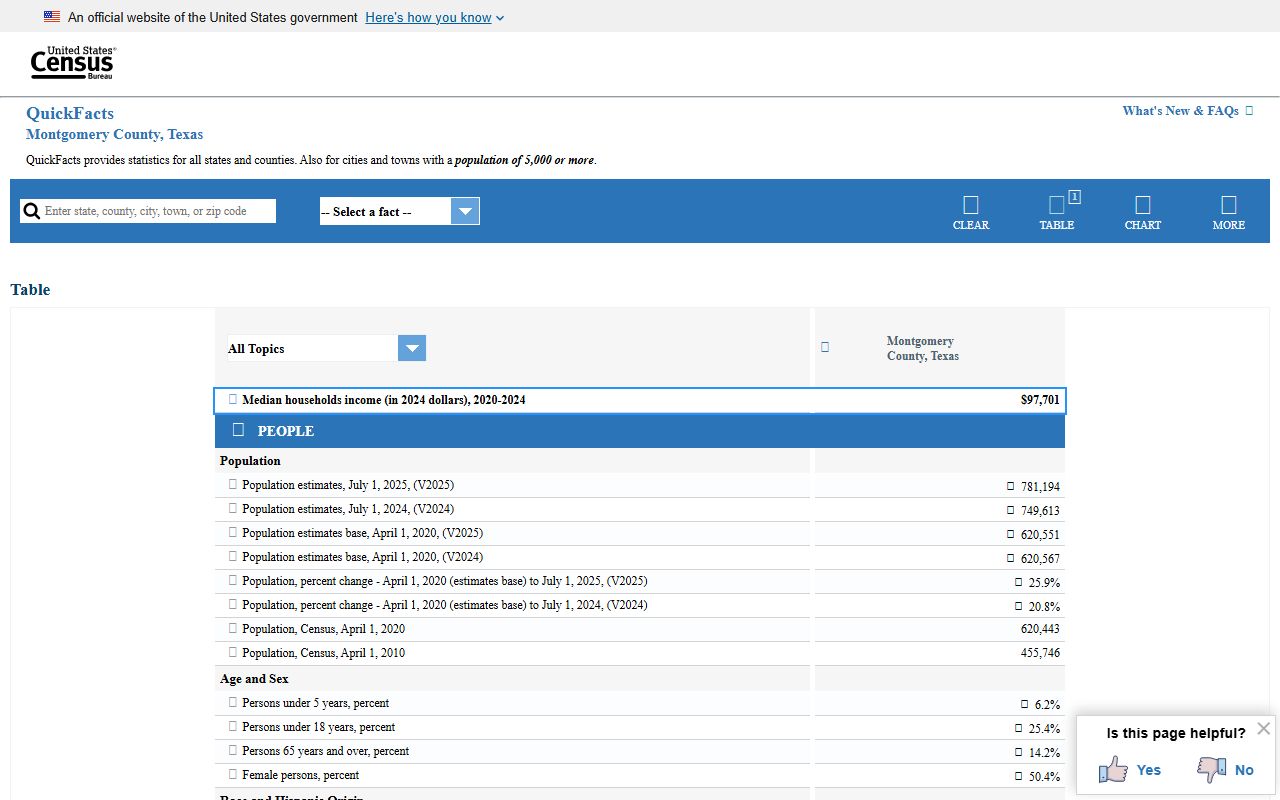
The clearest pressure on the jail population is county growth. The U.S. Census Bureau tracks how fast Montgomery County is adding people. The 2020 Census put the county at 620,443 residents. By July 1, 2024, the estimate rose to 749,613. By July 1, 2025, it reached 781,194. You can confirm these figures at U.S. Census Bureau QuickFacts for Montgomery County. More residents tend to bring more arrests, more cases, and more demand on jail beds.
That growth shows on the QuickFacts page in plain figures.
There is a second sign of pressure. The Sheriff's Office reports that Montgomery County houses some inmates in Waller County due to overcrowding. A county does not arrange overflow housing unless its own beds run tight. So the Waller County partnership is real evidence that the jail population has pushed against local capacity. It does not give an exact count, but it does show the trend direction.
For the exact jail counts month by month, the TCJS reports are the record. The Census numbers explain the why. The Waller County fact confirms the squeeze. The TCJS data supplies the actual headcount. Read all three together for a full view of how the jail population has shifted.
Searching for Montgomery County Inmate Records by Name
Population data is different from a single-person lookup. To find one named person in custody, view booking photos, or check whether someone has been released, use the inmate records page, which explains the Sheriff's roster and the lookup steps; for release follow-up, see the released inmates page, and for active warrants tied to a name, see the warrant records page.
Where Montgomery County Jail Population Data Comes From
Five sources carry the numbers behind this topic. Each one has a clear role. TCJS is the state authority on county jails. The Sheriff's Office runs the jail and keeps its own records. BJS holds the national view. Vera adds county-level comparison. The Census Bureau supplies the population base used for rates.
The Texas Commission on Jail Standards is the first stop for current Texas figures. Its monthly reports and incarceration rate report hold the county-level data.

Vera lays its data out for county comparison, which helps when you want to see how Montgomery County sits next to its neighbors.

Use them in order. Start with TCJS for the current Texas count. Add the Sheriff's annual report for the local yearly picture. Pull BJS for the national frame. Bring in Vera for county-to-county comparison. Anchor any rate with the Census population. One more local fact ties it together: the Jail Command runs with 334 sworn and civilian staff, including six lieutenants, seven sergeants, and 21 detention sergeants, with supervision 24 hours a day, every day of the year. That staffing level reflects the size of the job and the size of the population it manages.