
The Official Montgomery County Warrant Search Portal
The Sheriff's Office runs the official Montgomery County warrant search at a single web tool. The page is titled "Warrant Search." It lets the public look for people with active warrants in the county. You can search two ways. One way is by name. The other is by case or warrant number. The tool is free and open to anyone with a browser.
Before any search runs, the page asks you to prove you are human. This is a verification step, a kind of CAPTCHA. The page reads "Please verify you are human to enable search." Until you clear that step, the search buttons stay locked. So plan to pass the check first, then enter your details.
You can open the tool through the official Montgomery County Warrant Search page hosted by the Sheriff. The Sheriff is Wesley Doolittle. For warrant questions by phone, the Sheriff's Office line is 936-760-5800, and the menu offers option 4 for Warrants. Staff there can point you to the right office, though they cannot give legal advice.
How to Search for a Montgomery County Warrant
The steps are short. The hard part is having the right name spelling or the right number. A common name can return more than one match, so a middle initial helps narrow things. If a name search shows nothing, a warrant may still exist under a slightly different spelling, so try variations.
Here is the basic flow for a Montgomery County warrant search:
- Open the official Warrant Search portal in your browser.
- Clear the human verification step so the search buttons turn on.
- To search by name, type a full last name plus at least the first letter of the first name. Add a middle initial if you have one.
- Press the Name Search button to run the name lookup.
- To search by warrant number instead, type the warrant number, at least one character, and press the Warrant Number Search button.
- Read the result as a lead, then verify it with the Sheriff's warrants line or the issuing court.
The lead-in screen for the tool shows the two search modes. You can view the live portal at the official Montgomery County active warrant search page.
The screenshot below shows what the public sees when the page loads.
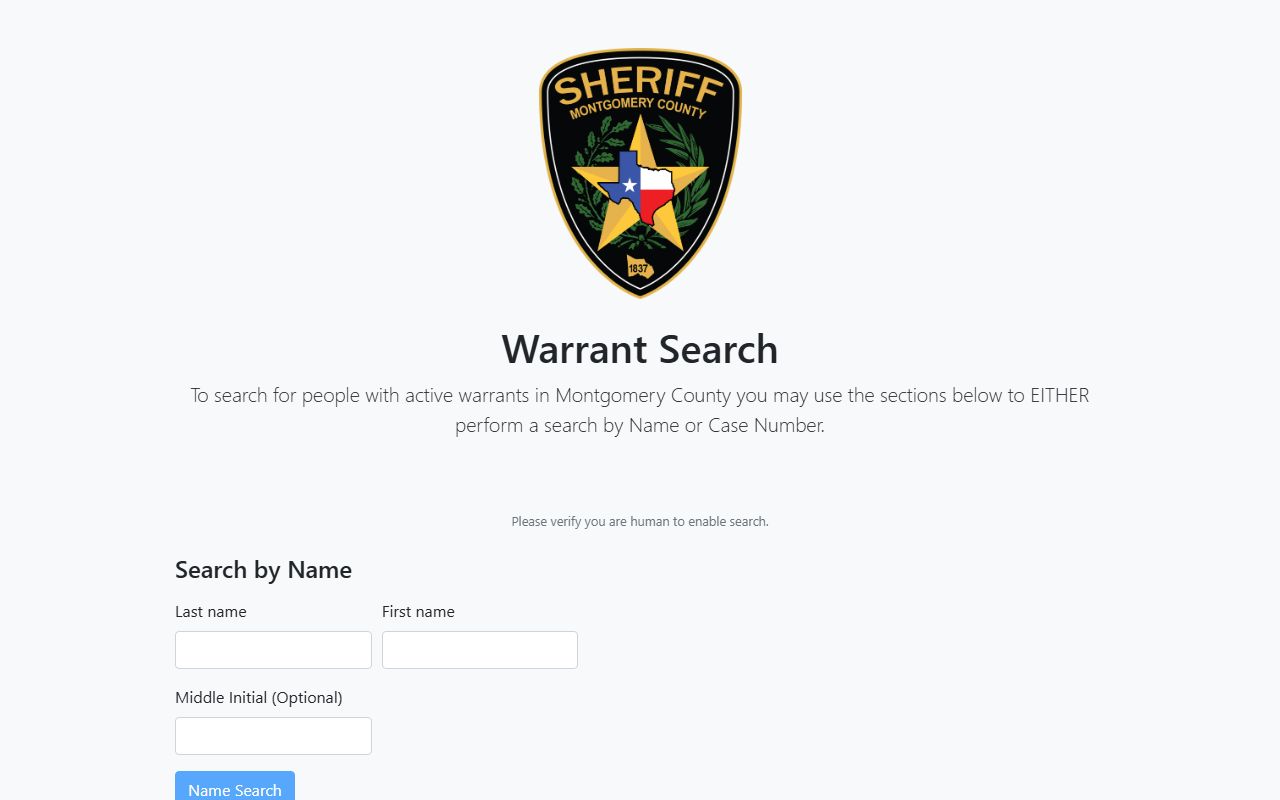
That landing screen is where both the name search and the warrant number search begin, after the human check clears.
Montgomery County Warrant Search Fields
The portal keeps its form simple. Each search mode has its own fields and its own button. The table below lists the fields on the Montgomery County warrant search tool and what each one needs. Two of the rows are buttons, and one is the human check that must clear before any search will run.
| Field Label | Type | Required | Notes / Format |
|---|---|---|---|
| Last name | Text | Yes | A full last name must be provided for a name search. |
| First name | Text | Yes | At least the first letter of the first name must be provided. |
| Middle Initial | Text | Optional | Helps narrow a common name. |
| Name Search | Button | n/a | Runs the name search. |
| Warrant Number | Text | Yes for that search | A value of at least one character in length is required. |
| Warrant Number Search | Button | n/a | Runs the warrant number search. |
| Human verification | CAPTCHA / control | Yes before search | The page must confirm you are human first. |
Use the name fields when you only have a person's name. Use the warrant number field when you have a number off a court notice or letter. You do not need both. Each mode runs on its own.
Types of Montgomery County Warrants
Not every warrant is the same. The reason a court issues one shapes how you clear it. Some come from a new charge. Some come from a missed date. A few are tied to property rather than a person. Knowing the type tells you which office to call.
Here are the main warrant types you may see in Montgomery County:
- Arrest warrant: a judge or magistrate orders an arrest based on probable cause that a crime occurred.
- Bench warrant: a court issues it when someone fails to appear, ignores a court order, or is held in contempt.
- Capias: a writ that orders an arrest, common after an indictment, a failure to appear, or a judgment.
- Capias pro fine: used to enforce a fine or cost in a fine-only case when payment was not made.
- Search warrant: lets law enforcement search a property; an active one may be sealed and not public.
- Fugitive warrant or out-of-county hold: a warrant that comes from another county or state.
A capias and a bench warrant often grow out of the same root cause, which is a missed court setting. The terms get used loosely, but each rests on a court order. If you see one tied to an old case, the safest move is to call the court that issued it.
The Montgomery County Sheriff's Warrant Disclaimer
The Sheriff posts a strong warning on the warrant search tool, and it matters. The list is offered as a public service. It is not the same as an official court record. So a hit on the site is a starting point, not proof.
Important. The Sheriff's Office states the warrant information is provided as a service and is not considered an official court record. It is updated regularly but should not be used as confirmation or probable cause that any warrant is active. It should not be relied on for legal action. The Sheriff's Office asks that no citizen take individual action. The Office reserves the right to make changes and assumes no liability for errors, omissions, or discrepancies. The data is considered public record, and the page shows a last-updated timestamp.
Read that warning the way the Sheriff intends. Do not treat a name on the list as a green light to confront anyone. Do not treat a blank result as full proof that no warrant exists. The list can lag, and timing matters. To confirm a warrant for sure, you have to go to the source, which is the issuing court or the Sheriff's warrants staff.
What a Montgomery County Warrant Listing Is Expected to Show
The exact fields on a warrant result could not be confirmed. The human verification step blocked a full look at the live results in this pass. So the list below reflects fields the public listing is expected to show, based on how warrant tools usually work, not a verified screen capture. Treat it as a guide, not a promise.
A Montgomery County warrant listing is expected to include items like these:
| Field | What It May Show |
|---|---|
| Name | The person named on the warrant. |
| Warrant Number | The number tied to that warrant. |
| Charge / Offense | The offense behind the warrant. |
| Case Number | The court case linked to the warrant. |
| Issuing Court | The court that ordered the warrant. |
| Bond Amount / Type | The bond set, if any, and its type. |
| Date | The date tied to the warrant. |
Because these fields are not confirmed, verify any detail before you act on it. The right place to confirm a charge, a bond, or a court is the clerk or the Sheriff, not a screen. For broader case history, the Montgomery County court records portals and the arrest records page can fill in context.
How to Resolve a Montgomery County Warrant
Finding a warrant is one thing. Clearing it is another. The path depends on the court and the charge. A traffic warrant clears one way. A felony warrant clears another. The steps below keep you safe and on the right side of the process.
- Do not try to arrest or confront anyone. That is not your job, and the Sheriff asks the public not to act.
- Verify the warrant directly with the Sheriff's warrants line, the court clerk, or an attorney before you do anything else.
- Find out which court issued the warrant and get the case number tied to it.
- For a traffic or JP warrant, contact the issuing JP or municipal court about payment, an appearance, compliance, or a warrant recall.
- For a misdemeanor or felony warrant, contact an attorney or the court; turning yourself in may be needed.
- Post bond only through official jail, court, or bonding channels, never through anyone who promises a shortcut.
- Keep your receipts and court orders, then confirm the warrant clears from the system.
For felony matters, the District Clerk is Melisa Miller, and the District Clerk office holds the case file. For county-level matters, the County Clerk holds the record. Use the case number from your warrant lead to reach the right clerk faster.
Montgomery County Traffic Warrants and Missed Court Dates
Many warrants in the county start with a traffic ticket, not a major crime. A missed justice court date can turn a simple citation into a capias. Once that happens, a routine fine becomes a warrant, and the cost climbs. The fix is usually to contact the court before things get worse.
The justice courts handle most Class C traffic cases by precinct. Precinct 4 publishes an extended payment plan option for people who cannot pay a fine in full. The applicant pays applicable state fees and court costs, then submits an application with supporting documents for review. You can read the details on the official JP4 extended payment plan page.
The image below shows the JP4 payment plan page that explains those options.
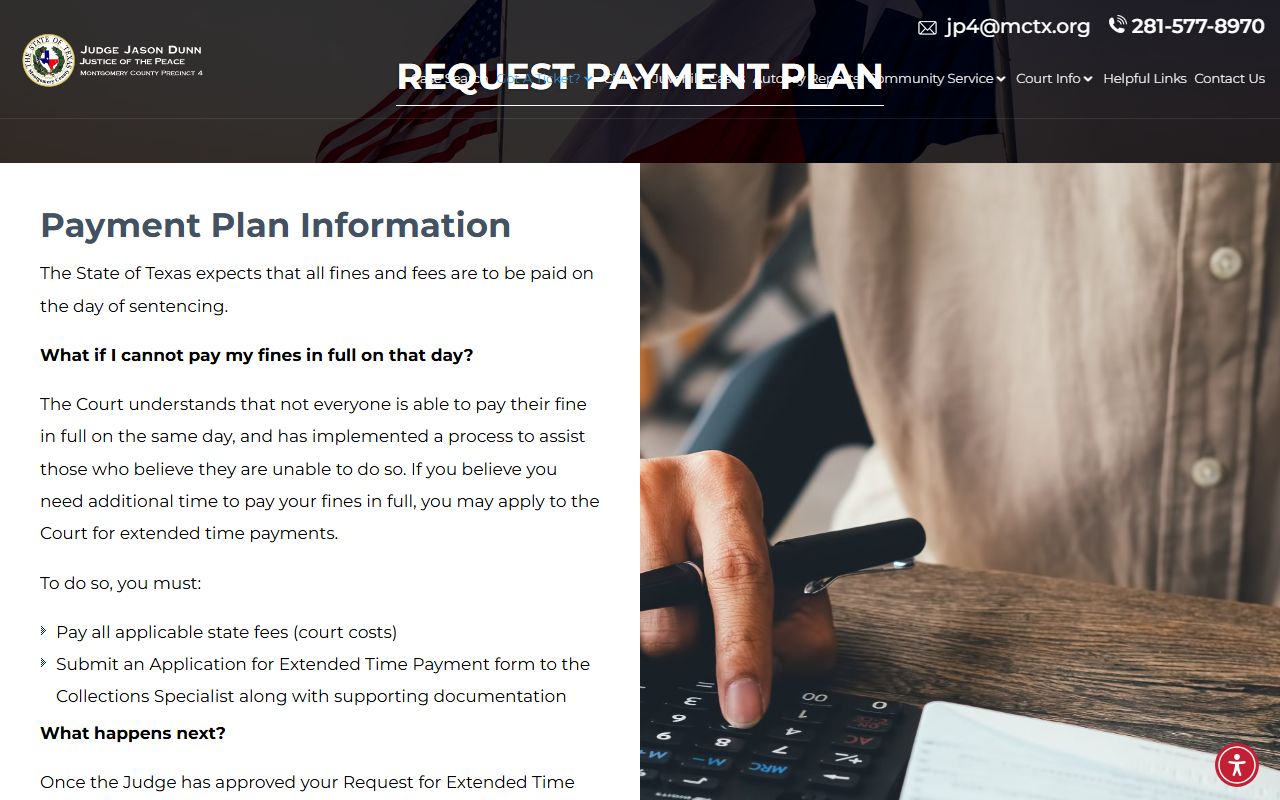
If your warrant traces back to a ticket, start with the precinct court and ask about payment, a plan, or a recall. For more on citations and how those cases work, see the traffic court records page.
Note: Acting fast on a missed traffic date often lets you set up a payment plan or recall a warrant before an arrest ever happens.
Texas Law Behind Montgomery County Warrants
Warrants in Texas follow set rules. The main law is Texas Code of Criminal Procedure Chapter 15. It governs arrest warrants and the capias process used by courts across the state, including Montgomery County. The chapter spells out who may issue a warrant, what it must contain, and how an arrest is carried out.
You can read the full chapter on the state's official site, the Texas Code of Criminal Procedure Chapter 15 page. It is the legal backbone for both arrest warrants and the capias writs that show up after a missed date or a judgment.
The image below shows that statute on the Texas Legislature site.
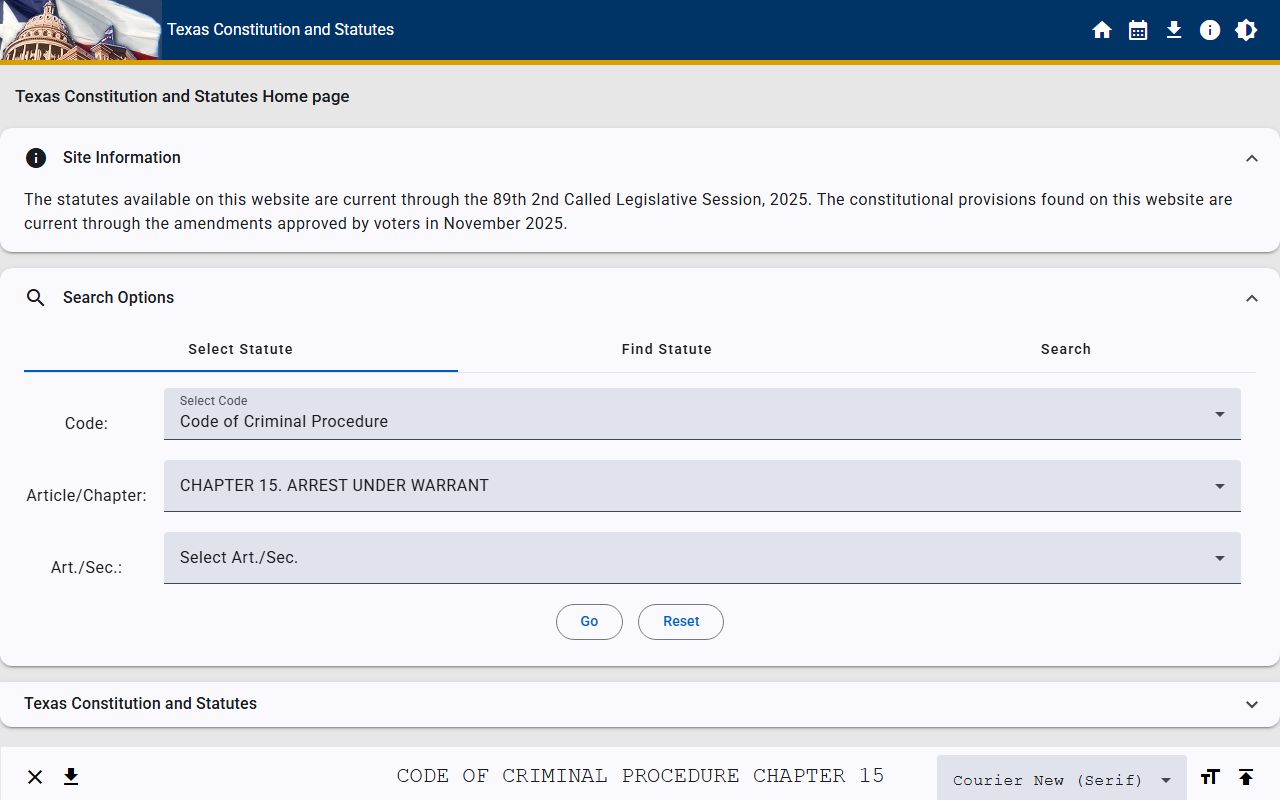
Reading the law helps, but it does not replace advice from a lawyer about your own case. If a warrant names you, an attorney can explain your options and how the chapter applies to your facts. For details on people held after an arrest, the inmate records page covers the jail roster and booking side.