
How to Find Recent Montgomery County Arrest Records
The fastest way to find a recent arrest is the jail roster. The Sheriff's Office runs the booking system at the county jail, and the public roster shows who is in custody right now. The jail page says you can search by name to learn if a person is housed in the MCSO jail and view booking photos. So the roster answers two quick questions. Is the person held? And what do the booking details show? The jail sits at #1 Criminal Justice Drive in Conroe, separate from the downtown courthouse. For inmate inquiries you can call 936-760-5800, option 1.
The public roster link now redirects to a County Corrections Public Access Portal login page. That means an account may be needed before the full search opens. The Sheriff still treats the roster as the official custody reference. When a name drops off the roster, the person has left county custody. Bond, transfer, or release can change a record at any hour, so a roster check is a snapshot, not a final word.
Sheriff Wesley Doolittle leads the office that holds these arrest records. For a deeper walk through the booking system and custody status, the inmate records page covers the roster in detail. If you are checking on an active arrest order rather than a booking, the warrant records page handles that search.
Start your search on the District Clerk side when you need the matching court file. The criminal case search entry point is shown below.
The district criminal case lookup opens through the official District Clerk Odyssey criminal case search.
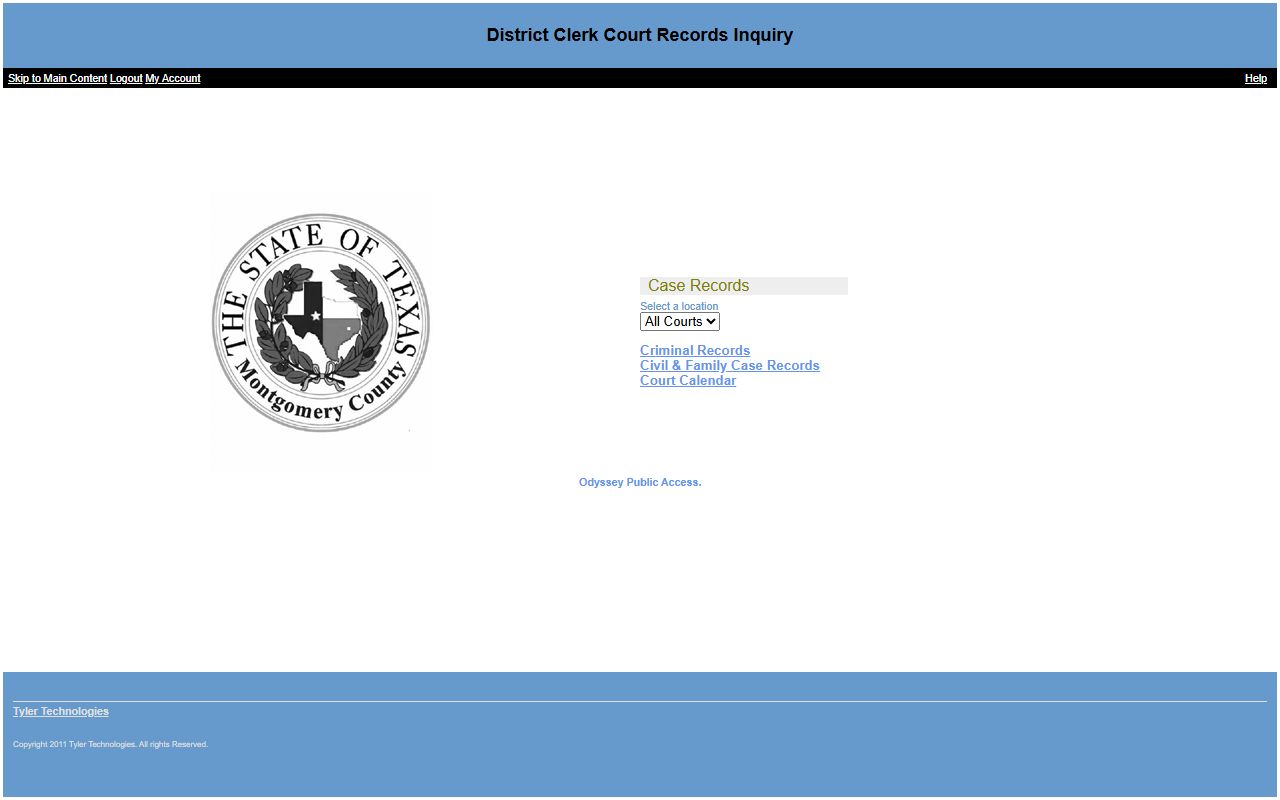
That portal pulls felony filings tied to an arrest, while the jail roster covers the booking side of the same event.
Arrest Records vs Criminal Court Records in Montgomery County
An arrest record and a criminal court record are two different files. The arrest record, or booking record, is made by the Sheriff at the jail. It captures the moment a person is taken into custody. The criminal court record is made by a clerk once a charge is filed in court. One is a law-enforcement record. The other is a court record. They can describe the same incident, yet they live in separate systems and update on different clocks.
This split matters for your search. A booking can show up on the jail roster within hours. A court case may not appear until prosecutors file a charging document, which can take days or longer. So a person may be booked and on the roster while no court case exists yet. The reverse is also true. An old case can sit in court records long after the person left the jail.
The table below lays out the core differences. Use it to pick the right place to look.
| Arrest Record | Criminal Court Record |
|---|---|
| Made by the Sheriff at booking | Made by a court clerk at filing |
| Shows custody status and booking photo | Shows charges, pleas, and the final outcome |
| Found on the county jail roster | Found in the District or County Clerk portal |
| Updates as bond, transfer, or release occurs | Updates as the case moves through court |
| A snapshot of one event | The full history of a charge |
For the full court side of an arrest, the court records page maps the District Clerk and County Clerk systems. Felony files go to the District Clerk. Misdemeanor files go to the County Clerk.
What a Montgomery County Booking Record Shows
A booking record marks the start of the arrest record. The Sheriff's jail page says a name search tells you whether a person is housed in the MCSO jail and lets you view booking photos. The FAQ notes that the roster updates on release and may show a housing location, including a Waller County entry when overflow housing is used. The current portal requires account access from the public landing page, so some fields are only visible after sign-in.
Booking data tends to cover identity, the booking event, and the charges that brought a person in. A criminal court file goes further. It ties everything to a case number and tracks the case to its end. The fields below are the common court-record items in the county case systems.
- Case number, the clerk's unique ID for the matter.
- Court, such as a district court or a county court at law.
- Parties, listed as the State of Texas against the accused.
- Filing date for the indictment, information, or complaint.
- Docket entries like motions, pleas, resets, and orders.
- Disposition, the final outcome of the charge.
Sensitive data is held back. Texas law protects Social Security numbers, driver license numbers, and similar fields, so a released copy may arrive with parts redacted. A booking photo is public on the roster, but a full investigation file may not be.
Montgomery County Mugshots and Booking Photos
A mugshot is the booking photo taken at the jail. The Sheriff's jail page states plainly that a roster name search lets the public view booking photos. So the official source for a Montgomery County mugshot is the county jail roster, not a private mugshot site. The photo is part of the arrest record and ties to the booking event.
A booking photo shows one thing only. It shows that a person was booked into the jail on a date. It does not show guilt. It does not show the result of any case. A photo can stay online while a person is in custody and then drop off once they are released. Because custody changes around the clock, a photo seen today may not match the roster tomorrow.
Treat a mugshot as a custody marker, not proof of a crime. The booking photo records an arrest. The court record records what happened next.
Note: A booking photo confirms only that an arrest and jail booking took place; it is not a finding of guilt and does not reflect any case outcome.
Charges vs Convictions in Montgomery County Arrest Records
This is the point people miss most. A charge is not a conviction. When a person is booked, the arrest record lists the charges police bring at that moment. Those charges are claims, not verdicts. A conviction comes only after a court process ends with a guilty finding or a guilty plea. Many charges never reach that point. Cases get dismissed, reduced, or sent to a different court.
So an arrest record can list a serious charge that later goes nowhere. The booking shows what a person was held for. The court file shows what actually happened. To learn the result, you have to read the disposition in the criminal court record, not the charge on the jail roster.
The table sets the two terms side by side.
| Charge | Conviction |
|---|---|
| An accusation at arrest or filing | A guilty finding or guilty plea |
| Appears on the booking record | Appears in the case disposition |
| Not proof of guilt | The court's final ruling on guilt |
| May be dropped, reduced, or dismissed | May carry a sentence or supervision |
| Set by police or prosecutors | Set by the court |
The county case glossary uses precise terms here. A disposition is the final outcome. A judgment is the court's written decision. A sentence is the punishment after a conviction. Deferred adjudication is a Texas route where a court may hold off on a guilty finding while a person finishes community supervision, which is the state term for probation.
How a Montgomery County Arrest Becomes a Prosecuted Case
An arrest does not file itself in court. The District Attorney decides whether to prosecute and in which court. Michael R. Holley is the District Attorney. He was sworn in on October 29, 2025 after an appointment by the Governor. His office sits at 207 W. Phillips, 2nd Floor, in Conroe, and the main line is 936-539-7800. The DA reviews arrests, screens charges, and carries cases through the courts.
The office is split into divisions by task. Division A handles felony trial courts, misdemeanor trial courts, and justice of the peace courts. That single division covers most of the day-to-day prosecution flowing out of arrests. Felony offenses are the serious crimes, and the division notes the county has four district courts with felony jurisdiction. Division B works special victims, domestic violence, human trafficking, child exploitation, and public integrity. Division C runs intake, major crimes, vehicular crimes, financial crimes, and elder abuse.
The DA homepage is the starting point for office contact and division links.
You can reach the office through the official Montgomery County District Attorney homepage.

That homepage names the District Attorney and gives the office contact details for criminal-records questions.
The biography page sets out when and how Holley took office.
His appointment is described on the District Attorney biography page.

Knowing who leads the office helps when you track a case from arrest to filing.
Division A is the team that turns most arrests into court cases.
Its work is laid out on the DA Division A page.

Once Division A files a charge, the arrest record links to a court case you can then search by name or case number.
Where the Montgomery County Criminal Court Record Lives
After an arrest is filed, the criminal court record sits with one of two clerks. The split follows the charge level. Felony files go to the District Clerk, Melisa Miller, and search through the District Clerk Odyssey criminal records section. Misdemeanor files go to the County Clerk, L. Brandon Steinmann, and search through the County Clerk Odyssey criminal records section. Pick the right clerk based on whether the charge is a felony or a misdemeanor.
Both systems use Tyler Odyssey, so the screens look alike. You choose a location first, then enter a name or case number. If a felony search shows nothing, the matter may be a misdemeanor on the county side, so check both before you stop. The arrest record gives you a name and a date to start the court search.
For the full clerk-by-clerk breakdown of these criminal records, see the court records page. The District Clerk page covers felony filings, certified copies, and the records and research area in more depth.
Statewide Criminal History vs Local Arrest Records
Local records and statewide records are not the same thing. A jail roster and a county court search show what happened inside Montgomery County. A statewide criminal history pulls reported records from across Texas. The Texas Department of Public Safety keeps the statewide criminal history system, and the rules for it come from Texas Government Code Chapter 411. That chapter governs criminal history record information and how DPS shares it.
So a clean local search does not mean a clean statewide record, and a statewide check may not show every county detail. The two serve different needs. A DPS conviction name search reflects reported convictions statewide. A county court search reflects the full docket of a local case, charges and all. People doing a careful review often check both, because each can hold facts the other leaves out.
The DA also handles formal records requests under open-government law. The office publishes how to send a Public Information Act request.
Those steps are posted on the District Attorney Public Information Act page.
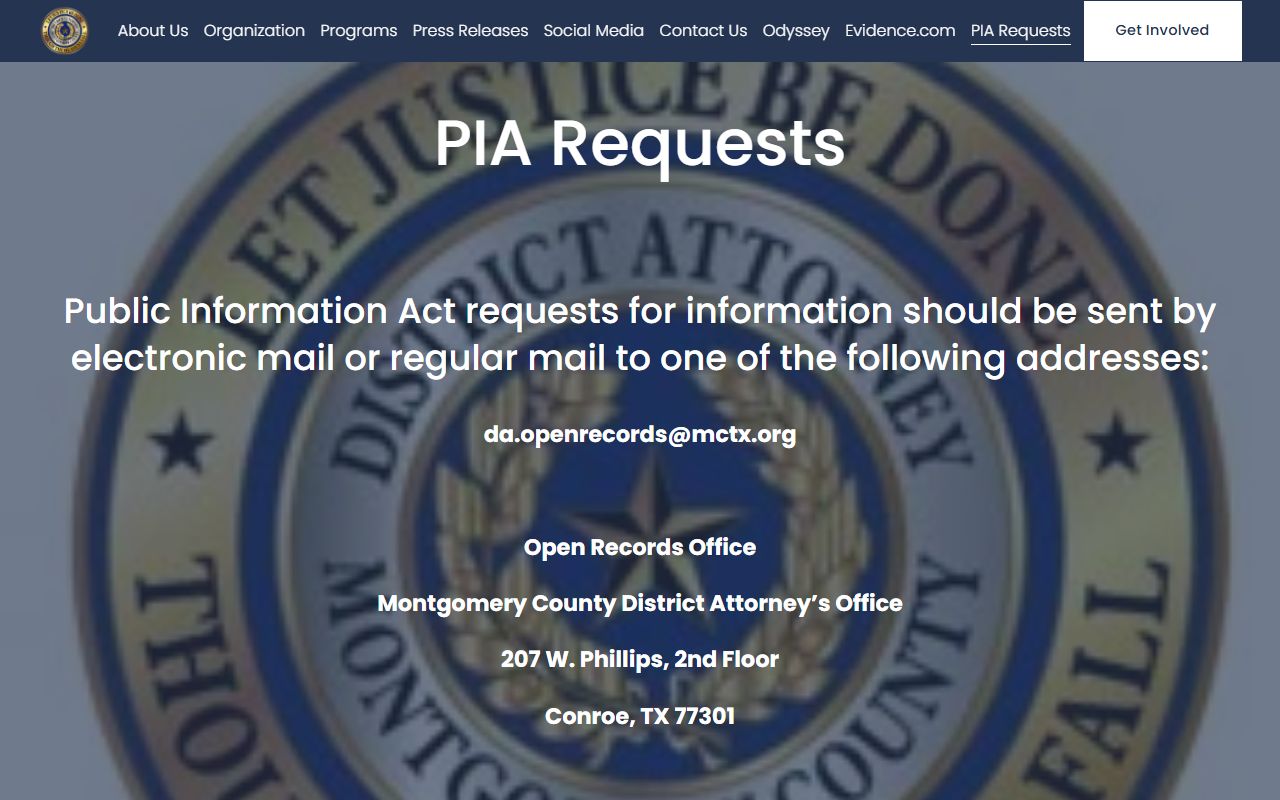
That page lists the email and mailing route for arrest-related records the DA holds rather than the clerks.
Public and Restricted Montgomery County Arrest Records
Texas opens most government records unless a law or court order closes them. The Texas Public Information Act, Government Code Chapter 552, governs county and sheriff records. Basic front-page arrest facts are often public, while an active investigation file may be held back under the law-enforcement exception. So one arrest can produce an open booking record and a closed case file at the same time.
Some arrest records stay closed by law. Juvenile records are restricted under Texas Family Code Chapter 58, and access is limited to a tight list of people and agencies. Mental health records fall under Health and Safety Code Chapter 611. Two other terms come up often. A sealed record is hidden from public view by a court order or by law. An expunged record is destroyed or removed under Code of Criminal Procedure Chapter 55, so agencies generally may not release it after the order.
The difference between sealing and expunction trips people up. The table below sets the two apart.
| Sealed Record | Expunged Record |
|---|---|
| Hidden from public view | Destroyed or removed from systems |
| Record still exists | Record is wiped from public access |
| Some agencies may still see it | Agencies generally may not release it |
| Often used through nondisclosure | Granted under Chapter 55 expunction |
| Limits who can view the file | Treats the arrest as if it did not occur |
An order of nondisclosure is the common path to sealing eligible criminal history, often after deferred adjudication ends well. Expunction is harder. A person files in district court, names every agency that may hold the record, and proves eligibility. For background-check use, this all matters a great deal. Public arrest data is not a consumer report, and it may not be used for hiring, housing, or credit decisions. A DUI or DWI arrest also overlaps with traffic enforcement, and the traffic court records page covers how those driving-related cases are handled.
For records the DA office holds, the contact page lists the address and phone for direct questions.
Those details appear on the District Attorney contact page.
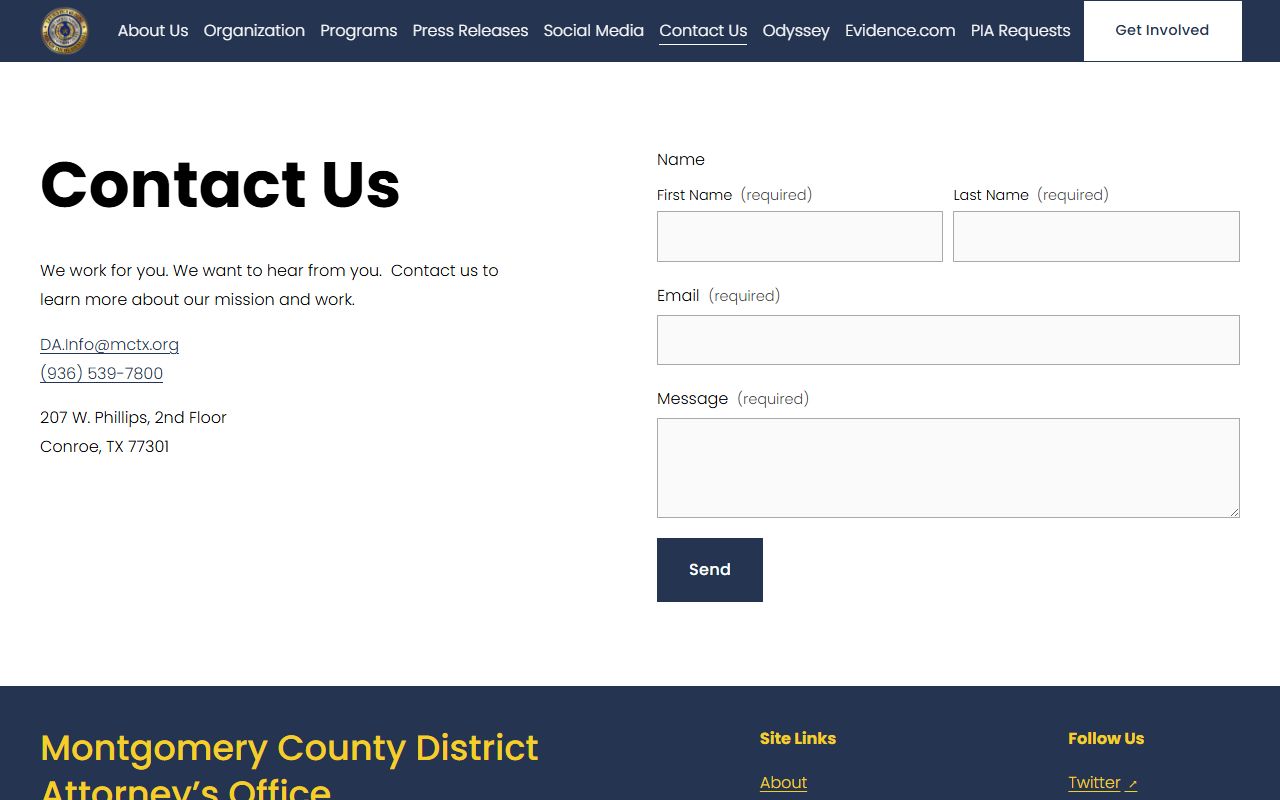
Clerks and DA staff can point you to records and forms, but they cannot give legal advice on sealing or expunction.