
What the Montgomery County Clerk Keeps in Public Records
The County Clerk, L. Brandon Steinmann, is the main custodian for recorded public records. The office sits at 210 West Davis, Conroe, TX 77301. The phone is 936-539-7885. These records go well past court cases. They form the public paper trail for land, business, and acts the law puts on file.
Real-property recordings are the heart of this work. The clerk records deeds and other instruments. Deeds show who holds title and what claims exist. Foreclosure notices are filed here too. So are liquor license filings. Assumed name records, also called DBA filings, tell the public who runs a business under a trade name.
The office holds a few records people do not expect. Livestock brands get recorded with the clerk. Military discharge papers, the DD-214, can be filed here. A veteran or family can later pull that copy. Vital records like birth, death, and marriage filings run through this same office. Some of those carry extra access limits.
Most of these items show up in the County Clerk Official Records Search. A grantor name can start a search. So can a grantee name, a subdivision, a document type, or a document number. The tool also shows a "certified through" date. That date tells you how current the index is.
Searching Montgomery County Public Records Online
The official records search is free to use. It is open to anyone. You can read the index, find a document number, and see what was recorded and when. To buy a copy or pull a full document, the site may ask you to register or sign in and use a cart. The search itself does not need an account.
The lead-in below points to the main search portal for recorded public records.
You can reach the search through the official County Clerk Official Records Search portal.
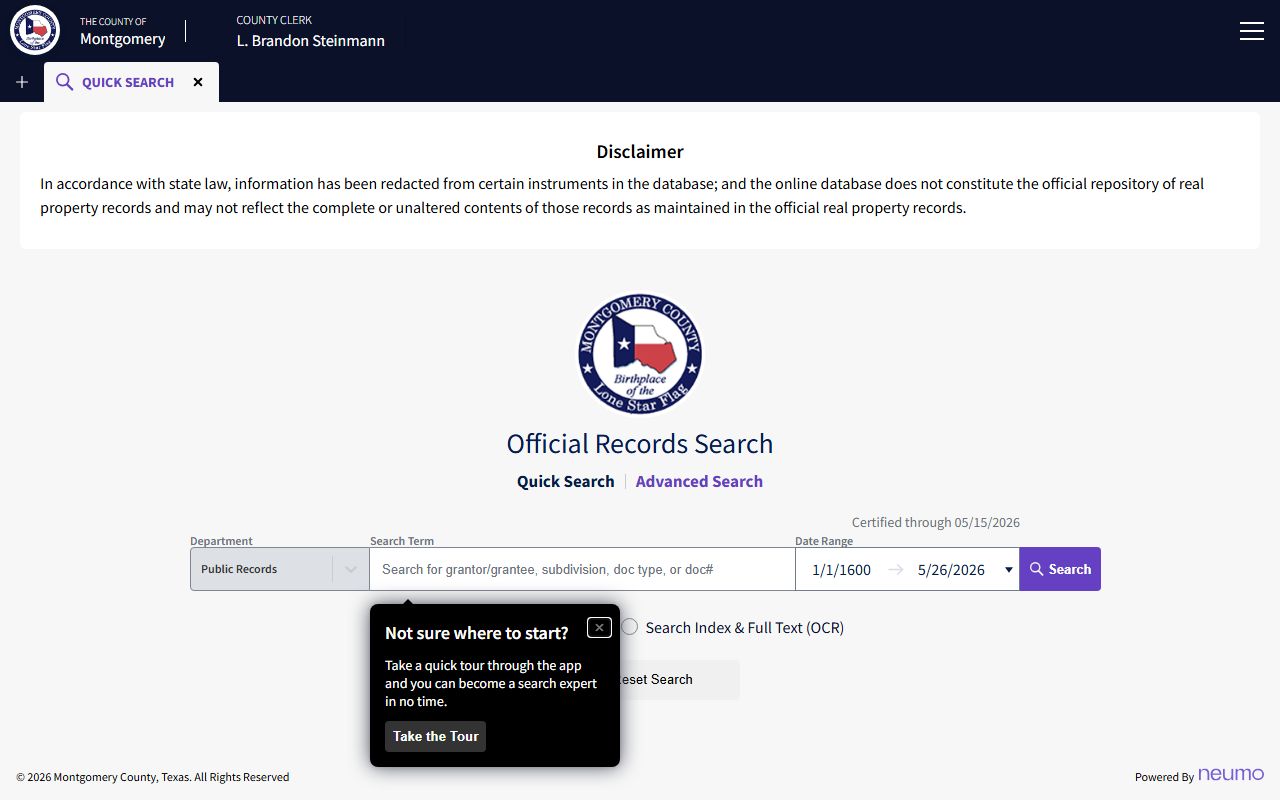
One choice on the page changes your results. An index-only search looks at the fields the clerk indexed. It treats each word on its own. The full-text OCR option reads the scanned text inside the documents. It treats two or more words as a phrase. Pick the index search when you know a name. Pick the OCR search when you need a phrase.
The county also runs a second address for the same records. If one link is down, the other gives the same data set.
The alternate route is the GovOS official records endpoint for the County Clerk.
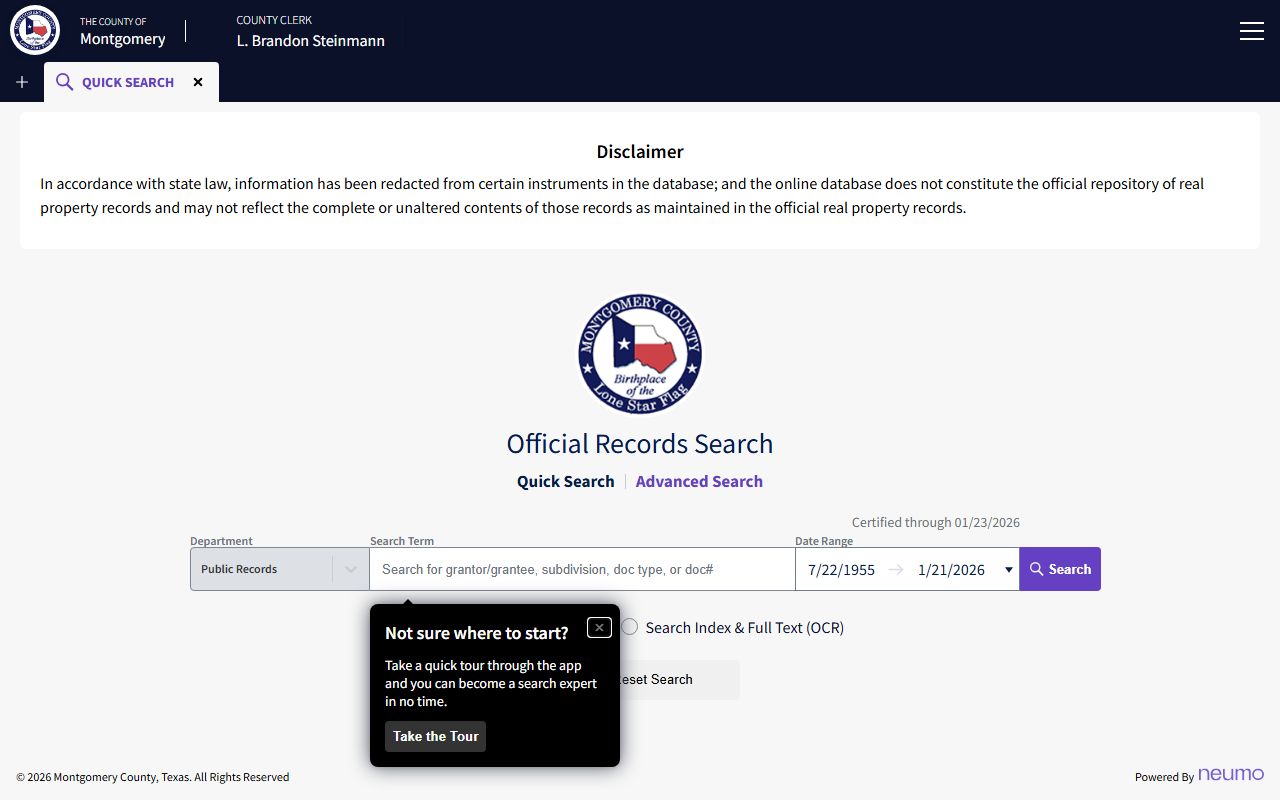
Quick date filters speed up a search. Use them when you only need recent activity. The portal offers ranges from the last 24 hours out to the last full year. Use a recorded date range to box in older filings.
Montgomery County Public Records Search Fields
The official records tool keeps its search screen simple. You enter a term. You set a date window. You choose how wide the search should reach. The table below lists each field and what it does. No field is strictly required, but a term plus a date range gives the best result.
| Field Label | Type | Required | Notes / Format |
|---|---|---|---|
| Search Term | Text | No | Grantor or grantee name, subdivision, document type, or document number |
| Date Range | Date from / to | No | Filters by recorded date; set a start and end date |
| Quick Date | Buttons | No | Last 24 hours, 3 days, 1 week, 2 weeks, 1 month, 3 months, 6 months, 1 year |
| Search Scope | Radio | No | Search Index Only or Search Index & Full Text (OCR) |
| Search | Button | n/a | Runs the query against the recorded index |
| Reset Search | Button | n/a | Clears all fields and starts over |
Each scope fits a different need. Index-only is fast. It works well for a known name or number. Full-text OCR digs into the words inside scanned pages. That helps when the index is thin or the spelling is odd. Try one, then switch if the first comes up short.
If a search returns nothing, the cause is often small. A name may be spelled a new way. A record may be too old to be indexed. The item may sit with a court rather than the recorder. Marriage and divorce filings split between the County Clerk and the district courts. You can read about that on the marriage and divorce records page.
The Texas Public Information Act and Montgomery County Records
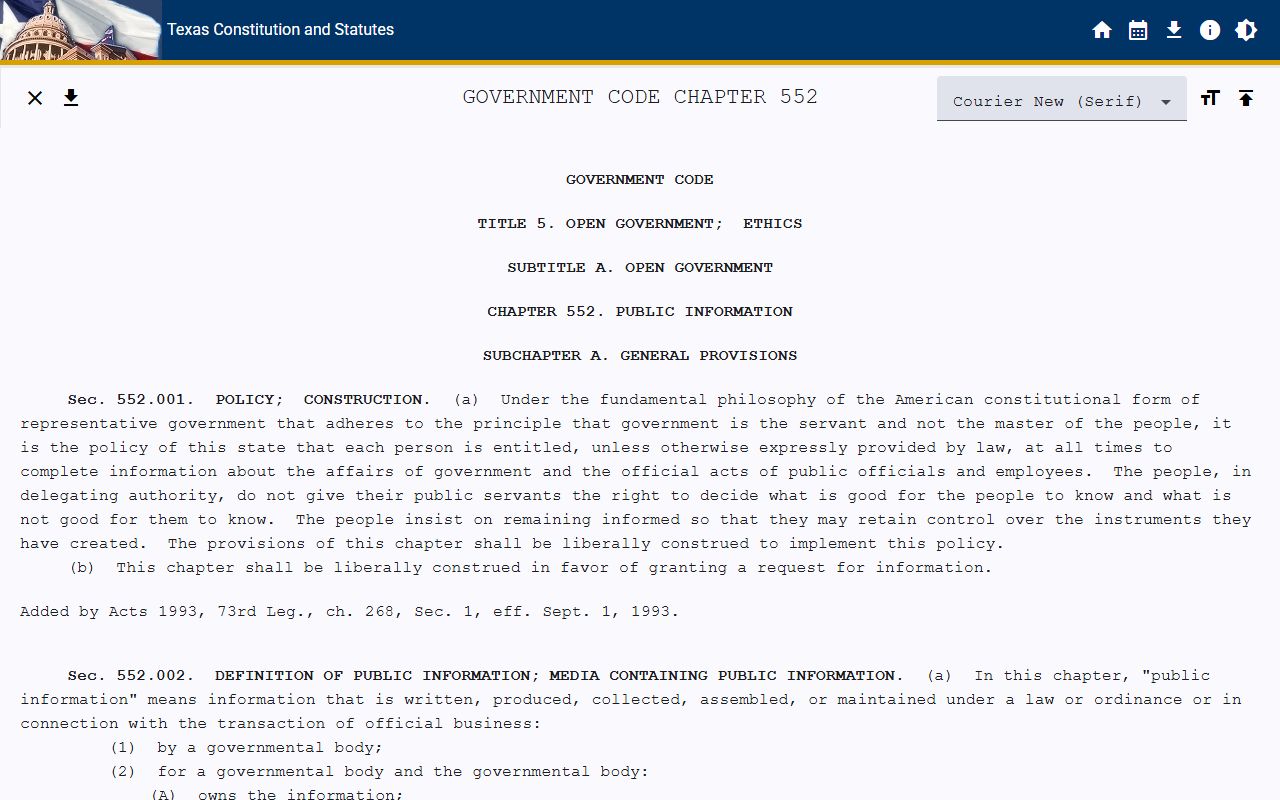
Texas starts from openness. The Texas Public Information Act, Government Code Chapter 552, says people are entitled to full information about what their government does. Records held by a governmental body are public unless a law or court order closes them. That covers many county, sheriff, and district attorney records.
The lead-in below points to the statute that frames every request.
You can read the law on the state's Government Code Chapter 552 page.
Court files add a second layer. They follow judiciary rules on top of the open-records idea. So the same event can make an open court file and a closed agency file at once. A felony case may be public in the court docket. Parts of the police file may stay shut during the case.
This is why naming the right custodian matters. The District Clerk holds district court files. The County Clerk holds county court, probate, and recorded public records. The Sheriff holds arrest and jail records. The District Attorney holds prosecution files. The Department of Public Safety holds statewide criminal history. A city department holds its own files. Send a request to the wrong office and you face delay.
How to File a Montgomery County Public Records Request
A clean request gets a faster answer. First, find which office holds the file you want. Then use the right tool or route to ask. The steps below walk through the process from start to finish.
- Identify the custodian first. Decide if the file belongs to the District Clerk, County Clerk, Sheriff, District Attorney, DPS, or a city.
- Use the public search first where one exists. The official records portal and the court case portals answer many lookups with no formal request at all.
- Put the request in writing when you need agency records. A written request creates a record of what you asked and when.
- Be specific. Give names, dates, case or document numbers, the court, and the exact item you want. A broad ask like "all records about a person" can draw delay or a cost estimate.
- Expect redactions. Texas law shields items like Social Security numbers, driver license numbers, and other protected data, so a released copy may arrive with parts blacked out.
- Know what you are asking for. Inspection lets you read a file. A plain copy is a simple printout. A certified copy carries the clerk's seal for legal use. Staff research on old or offline files can add time and cost.
- If denied, ask which law applies. For agency records, the office often must cite a statutory exception and may need an Attorney General ruling. For court records, the path may be a court motion instead.
Keep your contact details on the request. That way the office can reach you with questions or a cost estimate. A good request also names a date range. That keeps the search tight and the cost low.
Montgomery County DA Public Information Act Requests
The District Attorney takes open-records requests through a set route. You can ask for DA records by email or by mail to the Open Records Office. The office handles prosecution-related files. Those files often carry strong exceptions while a case is active.
The table below lists the two ways to send a Public Information Act request to the District Attorney. It also notes what your request should include.
| Field / Instruction | Type | Required | Notes |
|---|---|---|---|
| Send by email | Submission method | No | Email the request to da.openrecords@mctx.org |
| Send by regular mail | Submission method | No | Open Records Office, Montgomery County District Attorney's Office, 207 W. Phillips, 2nd Floor, Conroe, TX 77301 |
| Requester identity / records description | User-provided | Yes | Give your name and contact, then describe the records with names, dates, and case numbers |
Use one route or the other, not both. Email tends to move faster for routine asks. Mail works when you need a paper trail or want to enclose forms. Either way, a clear description speeds the reply.
Remember that DA files are not the same as court files. A felony court docket sits with the District Clerk. You can search it from the court records page. The DA's own work product may stay closed. The arrest records page explains how Sheriff and DA records fit together.
The Attorney General and Montgomery County Open Records
The Texas Attorney General runs the state's open-government work. A governmental body that wants to withhold records often must ask the Attorney General for a ruling. Requesters can turn to the office too. They can do so when they think they were overcharged, ignored, or wrongly denied.
The lead-in below points to the state office that issues these rulings and guidance.
Guidance and rulings come from the Texas Attorney General open-government division.

Court records work differently. A sealed court file usually follows a court process, not an AG ruling. So do not assume every clerk answer is an open-records dispute. For agency records the AG route applies. For court records the path may be a motion, a clerk step, or an appeal.
Note: The Attorney General reviews agency withholding under the Public Information Act, but sealed court files follow a court process instead.
Confidential Records in Montgomery County Public Records
Some files stay closed by law no matter who asks. These limits protect children, patients, and people whose cases the law treats as private. The custodian cannot waive them. A clerk cannot open a sealed file on request.
Juvenile records are restricted under Texas Family Code Chapter 58. Adoption records are confidential under Chapter 162. Mental health files fall under Health and Safety Code Chapter 611. Each sits outside the normal open-records path. Access usually needs statutory authority or a court order.
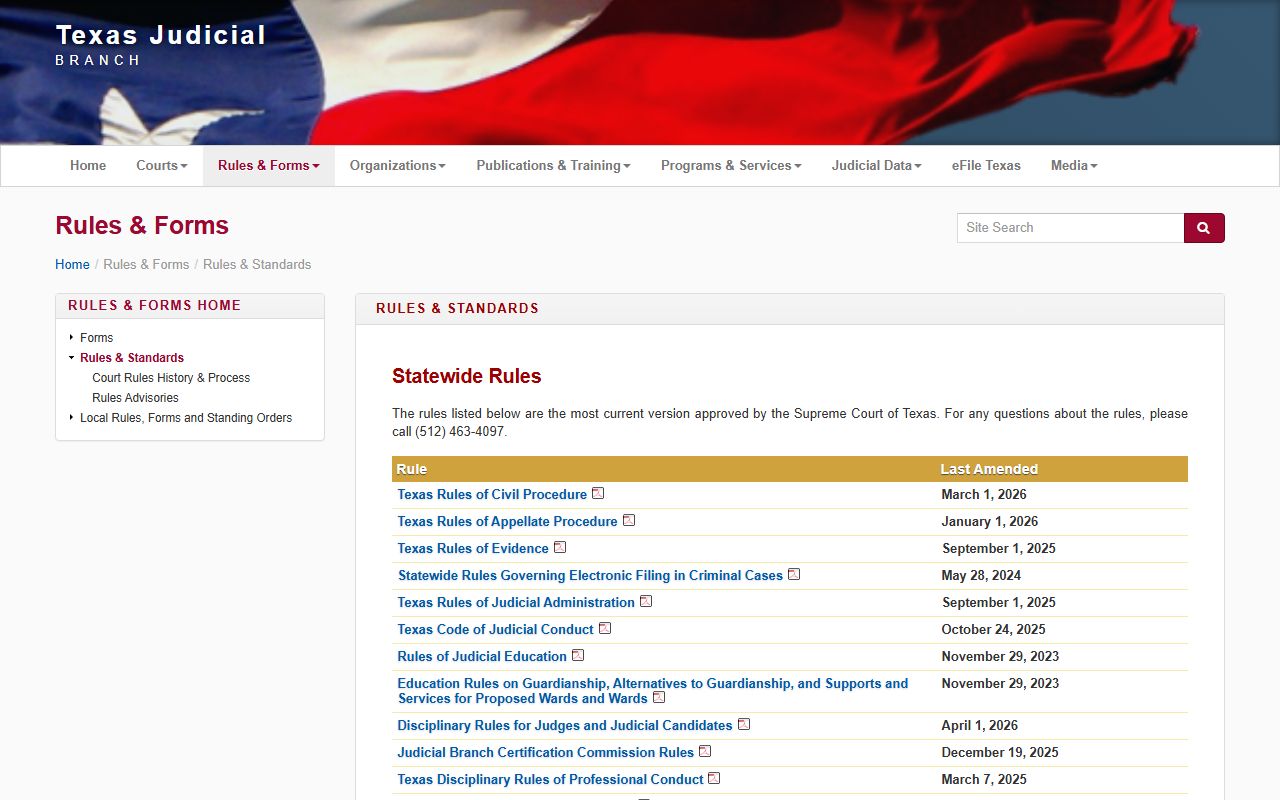
Court records can be sealed only under a strict rule. Civil court files are sealed under Texas Rule of Civil Procedure 76a. That rule calls for court findings and public notice before a seal can stand.
The lead-in below points to the rule set that governs sealing of civil court records.
You can find Rule 76a within the Texas rules and standards collection.
Two more limits hit criminal records. Expunged records are removed from public systems under Code of Criminal Procedure Chapter 55. So an eligible arrest may vanish from public view. Active cases can also be shielded by the law-enforcement exception in Government Code Section 552.108. That may hold back investigation details while a matter is open.
Fees and Certified Copies for Montgomery County Public Records
Costs depend on what you ask for and which office holds it. Reading a file may be free or low cost. A plain copy costs less than a certified copy. A certified copy costs more. The clerk certifies that it is a true copy for legal use. Always confirm the amount with the office before you pay.
The table below lists common items and where to confirm the charge. No figures are listed here on purpose. Fees change, and the official source is the only safe place to check.
| Item | Where to Confirm the Amount |
|---|---|
| Plain copy | County Clerk or District Clerk fee schedule for the office that holds the file |
| Certified copy | County Clerk or District Clerk certification fee on the official fee sheet |
| PIA labor and copies | Texas Attorney General cost rules and the responding agency's estimate |
| Recorded document copy | County Clerk recording fee sheet for official public records |
Under state cost rules, a Public Information Act charge can cover copies, staff labor, and postage. Yet many routine electronic requests are low cost or free. So do not assume a large bill. If a cost estimate looks high, ask the office to break it down. You can also narrow your request to cut the count.
Online portals may add their own download or card fees. Those are separate from clerk charges. For court-held items, the right office depends on the case type. The District Clerk page lays that out for district files. County court, probate, and recorded items run through the County Clerk instead.