
Texas District Courts Explained
District courts are the trial courts of general jurisdiction in Texas. That means they can hear the widest range of cases. A district court takes felony criminal matters, where the punishment can reach prison. It takes divorce and family suits. It takes large civil disputes over money, contracts, and property. The line between a district court and a lower court comes down to how serious the case is and how much money is at stake.
Each district court is run by an elected judge. The judge sets the docket, hears motions, presides over trials, and signs orders. Texas voters pick these judges for four-year terms. The state creates each court by number through the Legislature, so a court's number tells you when and where it was formed.
The Texas Judicial Branch keeps a clear chart of how the court system fits together. You can read the official overview on the lead-in page below.
The branch describes each court level on its about Texas courts page.
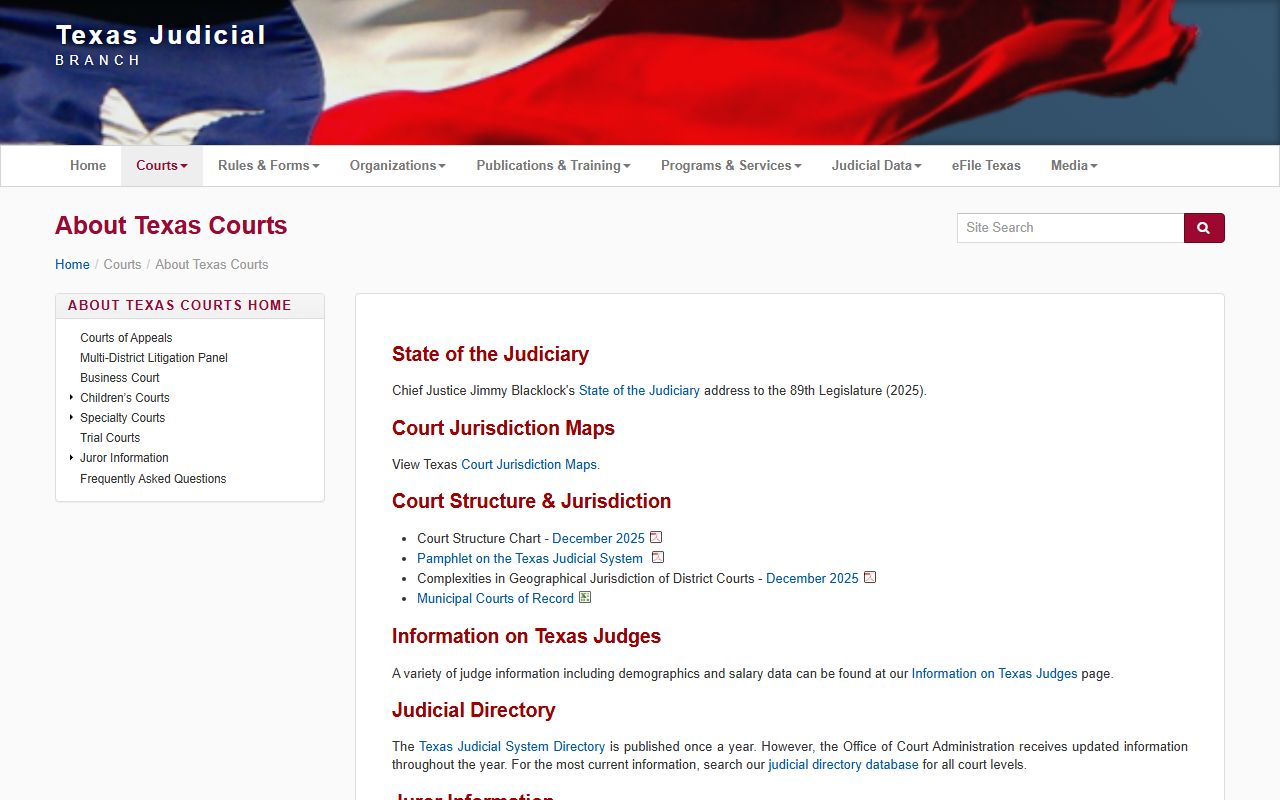
This statewide structure is the same one Montgomery County follows. The district courts sit near the top of the trial level, just under the appeals courts.
Montgomery County District Courts Overview
Montgomery County has eight district courts. They are the 9th, 221st, 284th, 359th, 410th, 418th, 435th, and 457th District Courts. All sit on the downtown court campus at 301 N. Main Street in Conroe. The courts share the same building footprint but each has its own judge, staff, and docket.
These eight courts split the heavy work. They hear felony criminal cases, where the State of Texas prosecutes the most serious charges. They hear family law, which covers divorce, custody, and child support. And they hear major civil suits that fall above the limits of the lower courts. Some courts lean more toward one type of case, but all of them carry a mixed docket assigned by law.
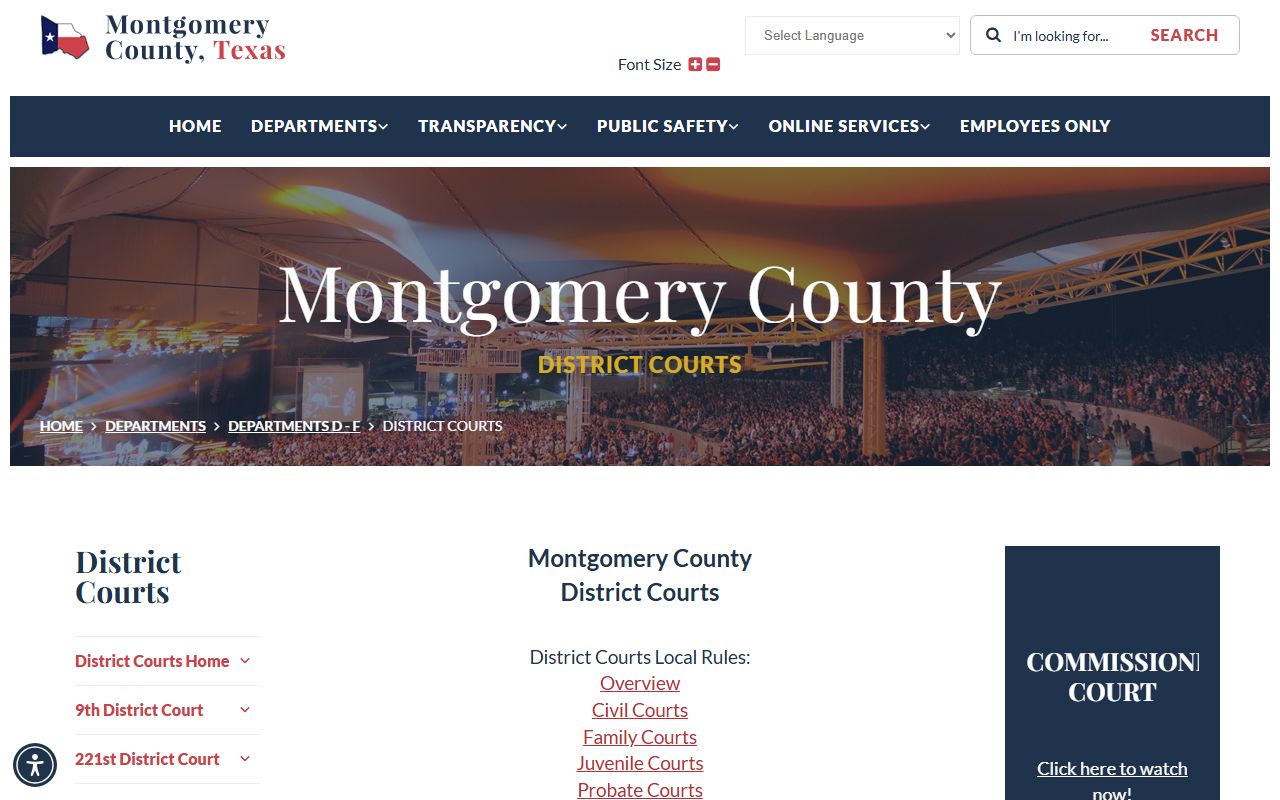
The county posts a single page that lists every district court with its own links and resources. The lead-in below points to it.
You can see the full list and each court's tools on the county's district courts page.
For the records side of these same cases, the Montgomery County court records page walks through the search portals.
The Eight Montgomery County District Courts
Each numbered court takes cases assigned to it under the local rules. Phone numbers for most individual courts are not published in one spot. Only the 410th District Court lists a direct line. For the other courts, the District Clerk is the right contact for case and filing questions. The table below lays out what each court handles and where to reach it.
| Court | What It Handles | Location | Phone |
|---|---|---|---|
| 9th District Court | Felony criminal, civil, and family matters | 301 N. Main, Conroe | Contact the District Clerk |
| 221st District Court | Felony criminal, civil, and family matters | 301 N. Main, Conroe | Contact the District Clerk |
| 284th District Court | Felony criminal, civil, and family matters | 301 N. Main, Conroe | Contact the District Clerk |
| 359th District Court | Felony criminal, civil, and family matters; Veterans Treatment Court link | 301 N. Main, Conroe | Contact the District Clerk |
| 410th District Court | Felony criminal, civil, and family matters; Judge Jennifer J. Robin | 301 N. Main, Suite 210, Conroe | 936-539-7860 |
| 418th District Court | Felony criminal, civil, and family matters | 301 N. Main, Conroe | Contact the District Clerk |
| 435th District Court | Felony criminal, civil, and SVP civil matters | 301 N. Main, Conroe | Contact the District Clerk |
| 457th District Court | Felony criminal, civil, and family matters | 301 N. Main, Conroe | Contact the District Clerk |
Do not read the blank phone fields as a sign a court is closed. They simply were not published. Route those calls through the District Clerk, who keeps the files for all eight courts.
A Closer Look at the 410th Montgomery County District Court
The 410th District Court works as a good example of how one of these courts runs day to day. Judge Jennifer J. Robin presides. The court is at 301 N. Main, Suite 210, Conroe, TX 77301. The published phone is 936-539-7860. Office hours are Monday through Friday, 8:00 a.m.-5:00 p.m., with a lunch closure from noon to 1:00 p.m.
The 410th also posts a clear filing warning. The court tells parties not to file a notice of hearing or send one out without first getting confirmation from court staff. That step keeps the docket clean and stops settings that the court never approved. It is a small rule, but it matters. Skip it and your hearing may not be on the calendar at all.
Note: The 410th District Court asks that you confirm a hearing date with court staff before you file or send any notice of hearing.
Other courts have their own quirks, but the basic pattern is the same. A judge, a staff team, set hours, and local rules that shape how you file and appear.
Local Rules in the Montgomery County District Courts
The district courts keep an extensive set of local rules. These cover civil, family, juvenile, probate, felony, and misdemeanor practice. Local rules tell you how to file, how to set a hearing, and what each judge expects in the courtroom. They sit on top of the statewide rules and fill in the local detail.
Some courts go further with standing orders. A standing order applies to every case of a certain type without the judge having to sign one each time. The 457th District Court, for instance, has a standing order on the use of artificial intelligence. That is a modern detail, and it shows how the courts adjust their rules as practice changes. The 284th publishes standing orders and practice tips, and the 435th posts a standing discovery order.
If you file in any district court, read that court's local rules first. The clerk cannot give legal advice, but the rules and forms are public and free to read.
Civil, Family, and Felony Cases in Montgomery County District Court
Three big groups of cases fill the district court docket. Each one follows its own track from filing to judgment. Knowing which group your matter falls in helps you find the right court and the right record.
Felony criminal cases are the heaviest. The State of Texas brings these through the District Attorney. A case may start with an arrest, move to a grand jury, and then proceed to an indictment, plea, or trial. The record can hold the indictment, bond papers, plea documents, and the final judgment. For the arrest side of these cases, see the arrest records page.
Family cases include divorce, custody, child support, and protective orders. These are filed on the civil side of the district court. Some family files hold sensitive data about children and finances, so parts may be sealed or redacted. Major civil suits round out the docket. They cover contract fights, injury claims, and property disputes that climb above the dollar limits of the lower courts.
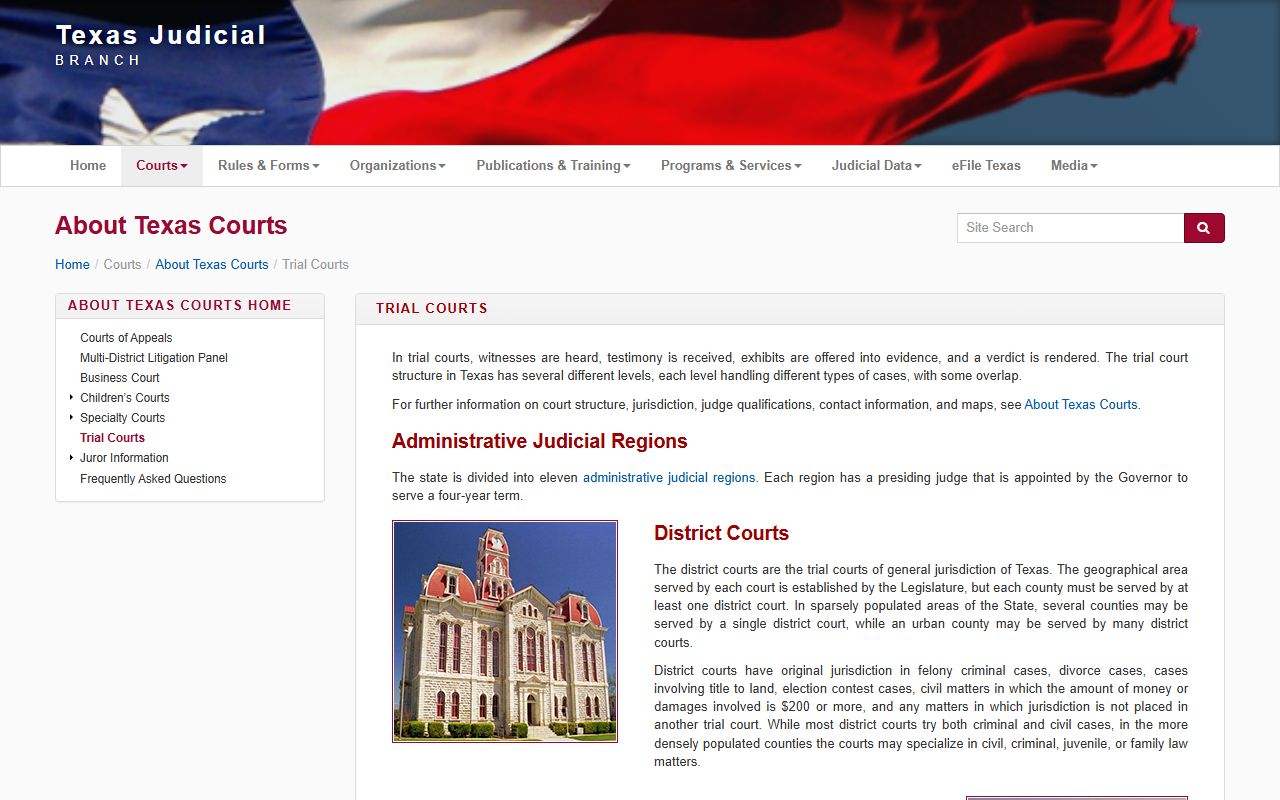
The Texas Judicial Branch sums up these trial-court roles on its trial courts page. The lead-in below links to it.
You can read more about each trial court on the branch's trial courts page.
To track hearing dates for any of these case types, the Montgomery County court dockets page covers the calendar search.
Specialty Courts Tied to the District Courts
Montgomery County runs two problem-solving programs that work with the district courts. These are not separate trial courts in the usual sense. They are specialty dockets that mix court supervision with treatment and support for people who qualify.
The first is the Drug Court. The county links it right from the district courts page. A drug court combines judicial oversight, treatment, drug testing, case management, and a system of rewards and sanctions. It serves defendants whose cases involve substance use. The program runs alongside the regular criminal docket rather than apart from it.
The second is the Veterans Treatment Court. The 359th District Court links it as a resource. This program serves eligible veterans whose contact with the justice system ties back to substance use, mental health, trauma, or trouble adjusting after service. It uses court supervision, treatment, veteran services, and mentoring. Both programs aim to cut repeat offenses by treating the root cause, not just the charge.
How a Montgomery County Case Moves Through the District Court System
Cases do not all start at the district court. Many begin lower and climb only if the stakes are high or a party appeals. The path depends on the type of case and how serious it is. The flow below shows the common route from the bottom up.
- Justice Court handles small claims, evictions, and Class C tickets.
- County Court at Law handles misdemeanors and lower civil suits.
- District Court handles felonies, family law, and major civil cases.
- A Texas Court of Appeals reviews the district court's decision.
- The Supreme Court of Texas takes civil and juvenile appeals; the Court of Criminal Appeals takes criminal appeals.
So a felony that ends in a conviction can be appealed from the district court to a court of appeals, and then to the Court of Criminal Appeals. A civil judgment follows the same first step but ends at the Supreme Court of Texas. The two high courts split the work by subject. One takes civil and juvenile matters, the other takes criminal.
For misdemeanors and county-level civil work, the Montgomery County courts at law page covers the level just below the district courts.
District Court Records and the Montgomery County District Clerk
The District Clerk keeps the records for all eight district courts. Melisa Miller serves as the District Clerk. The office is at 301 N. Main Street, Suite 103, Conroe, TX 77301, and the phone is 936-539-7855. This is the office to call when you need a certified copy of a district court file or have a question about a felony, family, or civil case.
The clerk runs the case search portal and handles e-filing, jury service, and records research. When a name search turns up nothing, the case may belong to the County Clerk instead, since misdemeanors and probate sit on that side. The clerk cannot give legal advice, but staff can hand you forms and point you to the right desk.
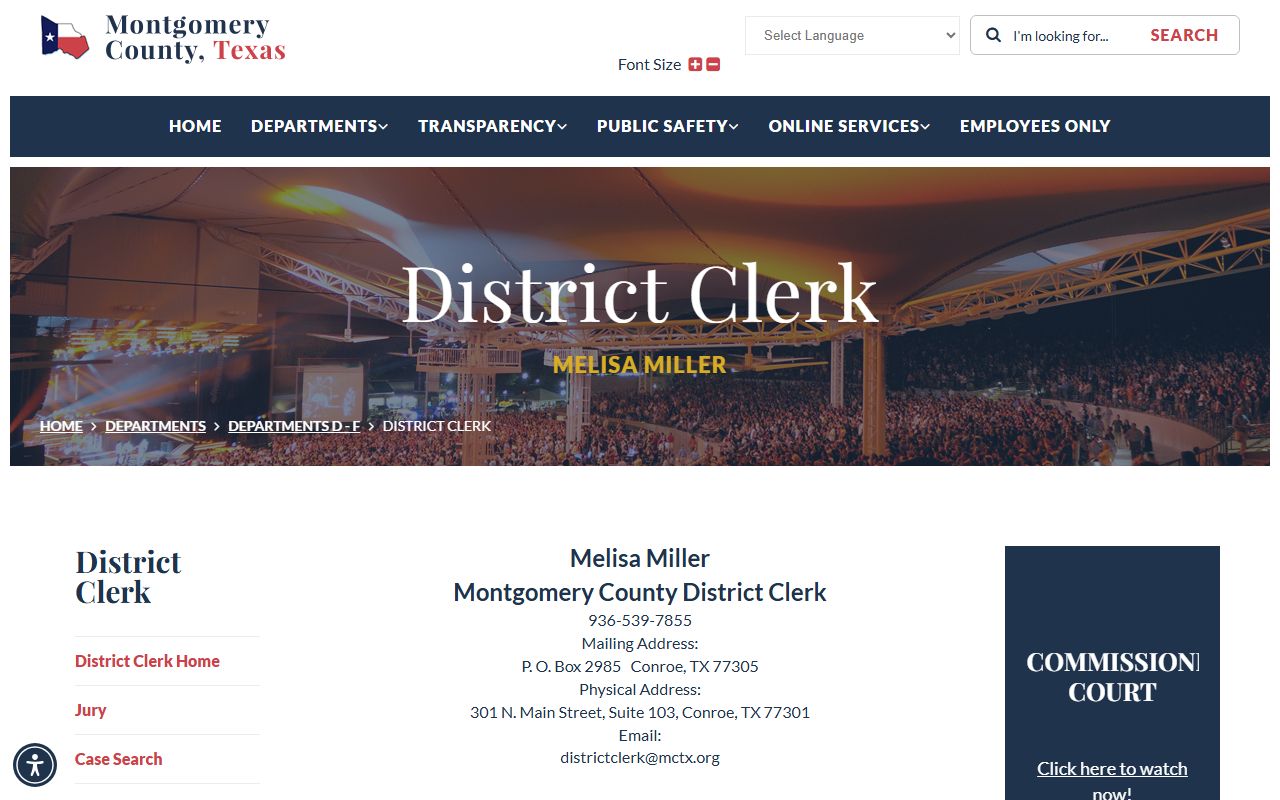
The lead-in below links to the official District Clerk page, which names the clerk and lists the case search and forms.
The county posts the office details on the District Clerk page.
To start a file search yourself, the District Clerk page and the court records guide both walk through the steps.
District Court vs County Court at Law vs Justice Court in Montgomery County
The three trial levels handle very different work. A quick side-by-side helps you place a case before you search. The district court sits at the top, the justice court at the bottom, and the county court at law in the middle.
| Feature | District Court | County Court at Law | Justice Court |
|---|---|---|---|
| Case types | Felony, family, major civil | Misdemeanor, mid-level civil | Small claims, evictions, Class C |
| Criminal level | Felony | Class A and B misdemeanor | Class C misdemeanor |
| Civil scope | Major civil and divorce | Lower civil within limits | Small civil and debt claims |
| Clerk / custodian | District Clerk | County Clerk | Justice court precinct |
So a felony goes to a district court, and its file sits with the District Clerk. A Class B misdemeanor goes to a county court at law, and its file sits with the County Clerk. An eviction stays at the justice court that heard it. Match the case to the level first, then go to the clerk that holds the record.